This is the fifth and final post in our five-part educational series, Indoor Cable Used Outdoors.
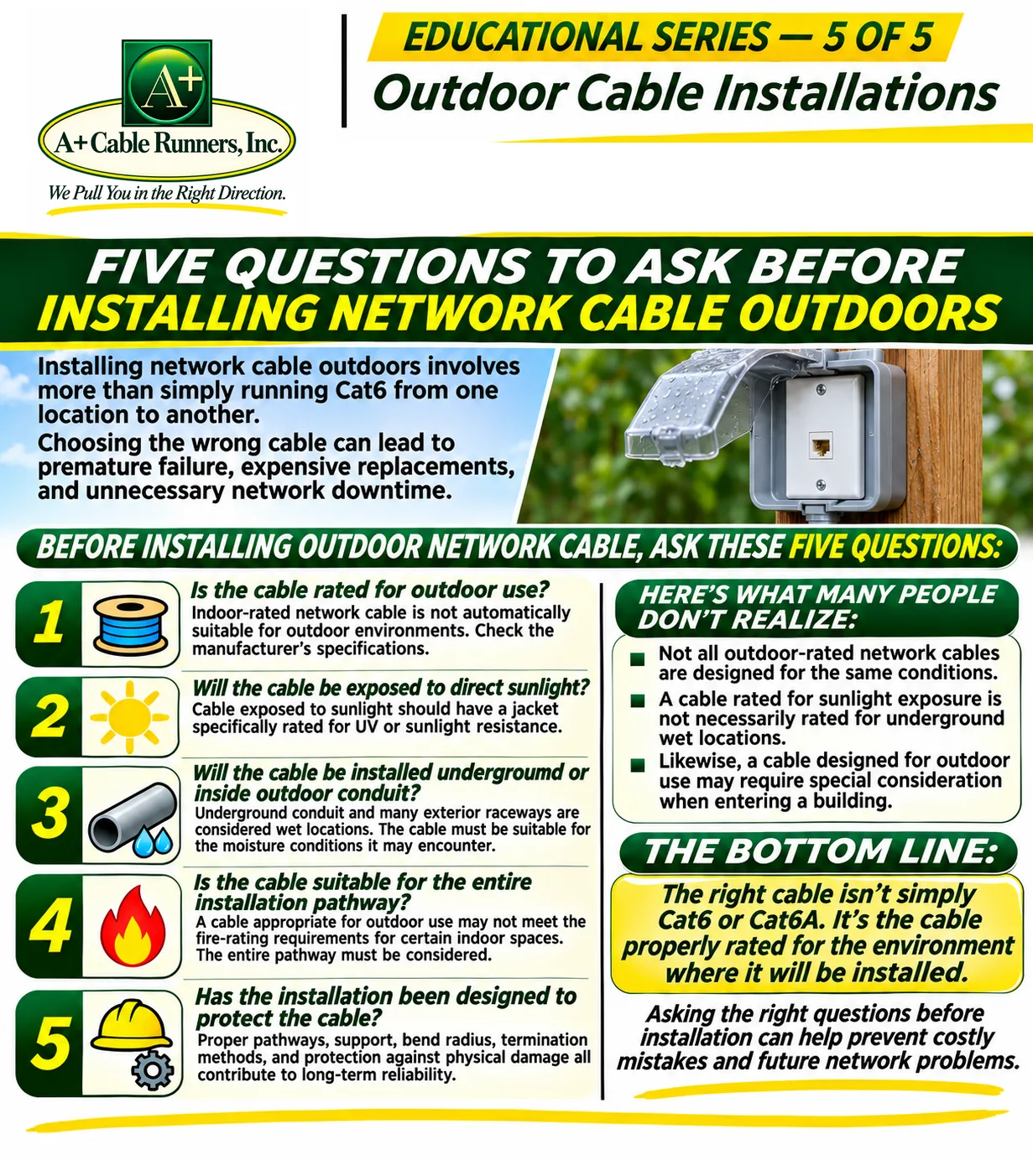
Installing network cable outdoors involves more than simply running Cat6 from one location to another. Choosing the wrong cable can lead to premature failure, expensive replacements and unnecessary network downtime. Before installing outdoor network cable, ask these five questions.
1. Is the cable rated for outdoor use?
Indoor-rated network cable is not automatically suitable for outdoor environments. Check the manufacturer's specifications. Part one of this series, indoor network cable used outdoors, explains what sunlight, moisture and heat do to cable that isn't built for them.
2. Will the cable be exposed to direct sunlight?
Cable exposed to sunlight should have a jacket specifically rated for UV or sunlight resistance. Our post on what the Florida sun does to the wrong cable covers the warning signs.
3. Will the cable be installed underground or inside outdoor conduit?
Underground conduit and many exterior raceways are considered wet locations. The National Electrical Code's general wiring rules treat the interior of underground raceways as a wet location (section 300.5(B)), along with the interior of raceways in wet locations above grade (section 300.9 in the 2020 edition). How those rules apply to a communications cable run is a design question for the local inspector, but the practical point holds either way: the cable must be suitable for the moisture conditions it may encounter. Our post on why outdoor conduit doesn't mean the cable stays dry goes into the details.
4. Is the cable suitable for the entire installation pathway?
A cable appropriate for outdoor use may not meet the fire-rating requirements for certain indoor spaces. The entire pathway must be considered. Cables listed for use inside a building carry designations that correspond to how they perform for the spread of fire and smoke, and outside plant cable often does not carry one. The National Electrical Code (section 800.48 in recent editions) allows unlisted outside plant communications cable inside a building only for a limited distance, generally no more than 50 feet from its point of entrance, ending at an enclosure or a primary protector. A common approach is to change to a properly listed indoor cable near where the run comes in. Exactly how the rule applies depends on the code edition in force and the local inspector, who has the final word.
5. Has the installation been designed to protect the cable?
Proper pathways, support, bend radius, termination methods and protection against physical damage all contribute to long-term reliability. Outdoor cable has its own installation details as well. Superior Essex, for example, says its armored outdoor cable requires special connectivity and that bonding and grounding are important, and points installers to its own installation guidelines. Our posts on types of cable supports and cable sag, pulling tension and bend radius cover the basics that apply indoors and out.
Here's what many people don't realize
- Not all outdoor-rated network cables are designed for the same conditions.
- A cable rated for sunlight exposure is not necessarily rated for underground wet locations.
- Likewise, a cable designed for outdoor use may require special consideration when entering a building.
Manufacturers say the same. Belden defines its general outdoor-suitable cable as withstanding sunlight, moisture and occasional rain, and says that definition does not cover harsher exposure such as water immersion. That is why the specification sheet matters more than the word "outdoor" on the box.
The bottom line
The right cable isn't simply Cat6 or Cat6A. It's the cable properly rated for the environment where it will be installed. Asking the right questions before installation can help prevent costly mistakes and future network problems.
If the run is between two buildings, our post on fiber vs. copper between buildings covers distance and lightning as well, and our post on six questions for comparing cabling bids covers what else to line up. To see the cabling work we do, visit our computer network cabling page.
Information is provided for general education. It is not a substitute for project-specific design, engineering or manufacturer instructions. Always follow applicable codes and listed system requirements. Project requirements should be verified individually.