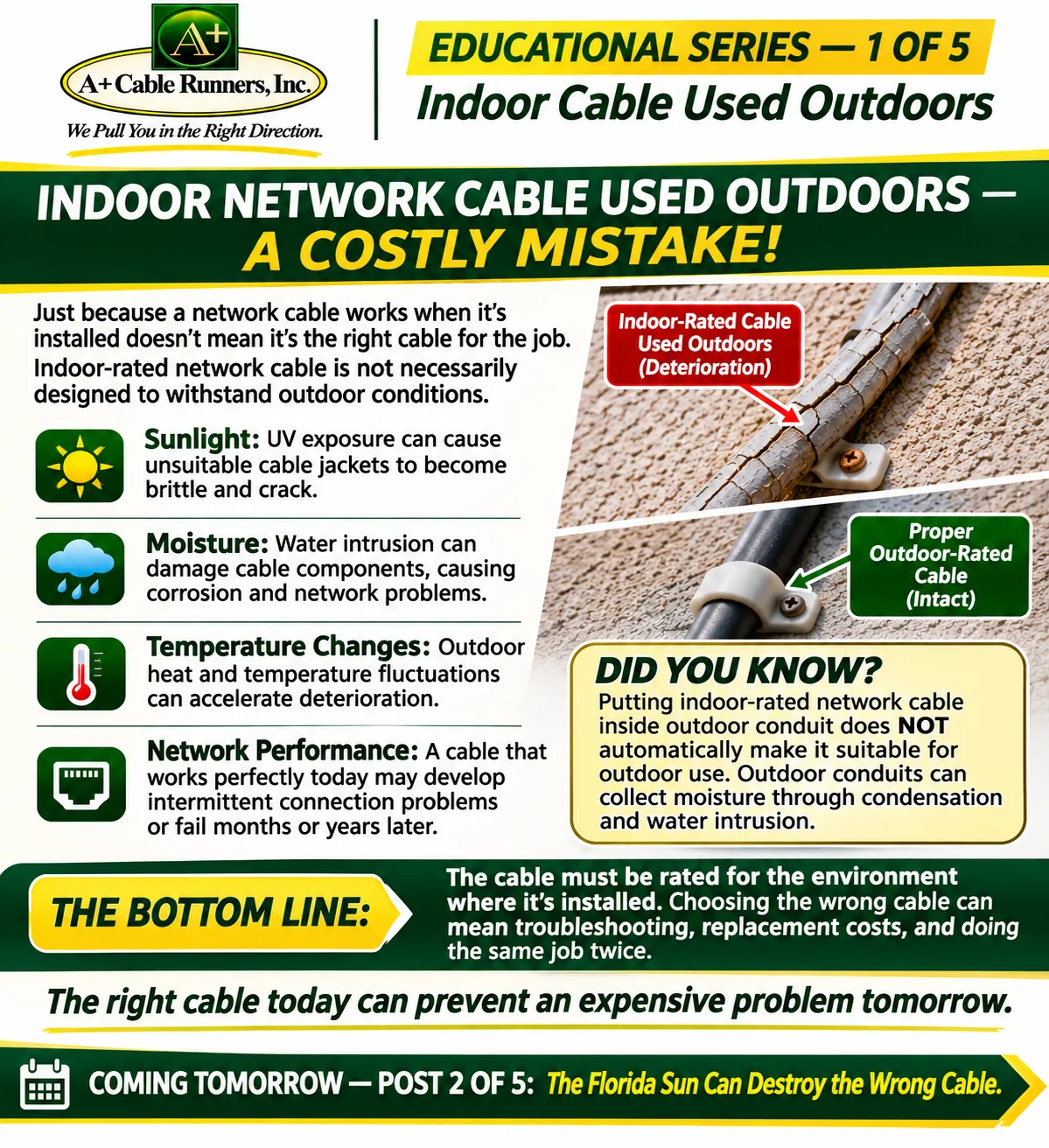
This is the first post in our five-part educational series, Indoor Cable Used Outdoors.
Just because a network cable works when it's installed doesn't mean it's the right cable for the job. Indoor-rated network cable is not necessarily designed to withstand outdoor conditions. A run along an exterior wall, out to a detached building or up to a device outside can pass its tests on day one and still be the wrong cable for the place it has to live.
What outdoor conditions do to the wrong cable
- Sunlight. UV exposure can cause unsuitable cable jackets to become brittle and crack.
- Moisture. Water intrusion can damage cable components, causing corrosion and network problems.
- Temperature changes. Outdoor heat and temperature fluctuations can accelerate deterioration.
- Network performance. A cable that works perfectly today may develop intermittent connection problems or fail months or years later.
What cable manufacturers say
Cable makers draw the same line between indoor and outdoor products. Belden's technical bulletin on outdoor suitability names the ultraviolet part of sunlight as the main concern, because it tends to damage the cable's jacket, so an outdoor cable's jacket has to be UV resistant. The same bulletin notes that high temperatures, including heat from the sun, accelerate a cable's aging and can lead to brittleness and cracking of the jacket or insulation.
Did you know? Conduit doesn't change the cable
Putting indoor-rated network cable inside outdoor conduit does not automatically make it suitable for outdoor use. Outdoor conduits can collect moisture through condensation and water intrusion. The National Electrical Code itself recognizes that condensation can form inside a raceway exposed to different temperatures. A Superior Essex technical guideline on twisted-pair cable in below-grade conduit goes further: it states that standard indoor CMR and CMP cables are not suitable for installation in wet locations, and that even conduit systems that have been dried cannot be trusted to remain dry. Part three of this series looks at conduit in more detail.
The bottom line
The cable must be rated for the environment where it's installed. Choosing the wrong cable can mean troubleshooting, replacement costs and doing the same job twice. The right cable today can prevent an expensive problem tomorrow.
The jacket is only one of the differences between cables that look alike. Our post on the hidden cost of cheap network cable covers the others, and our post on fiber vs. copper between buildings covers what to run when the cable has to cross a parking lot or a campus. To see the cabling work we do, visit our computer network cabling page.
Next in the series, part two: The Florida Sun Can Destroy the Wrong Network Cable.
Information is provided for general education. It is not a substitute for project-specific design, engineering or manufacturer instructions. Always follow applicable codes and listed system requirements. Project requirements should be verified individually.