This post goes with the last post in our five-part educational series on network cable. Post 4 covered the difference between a basic cable test and certification.
Not every network cabling bid covers the same work. Two contractors can quote the same number of connections and be proposing different cable, different installation methods and different testing. Here are six questions that turn a price comparison into a scope comparison.
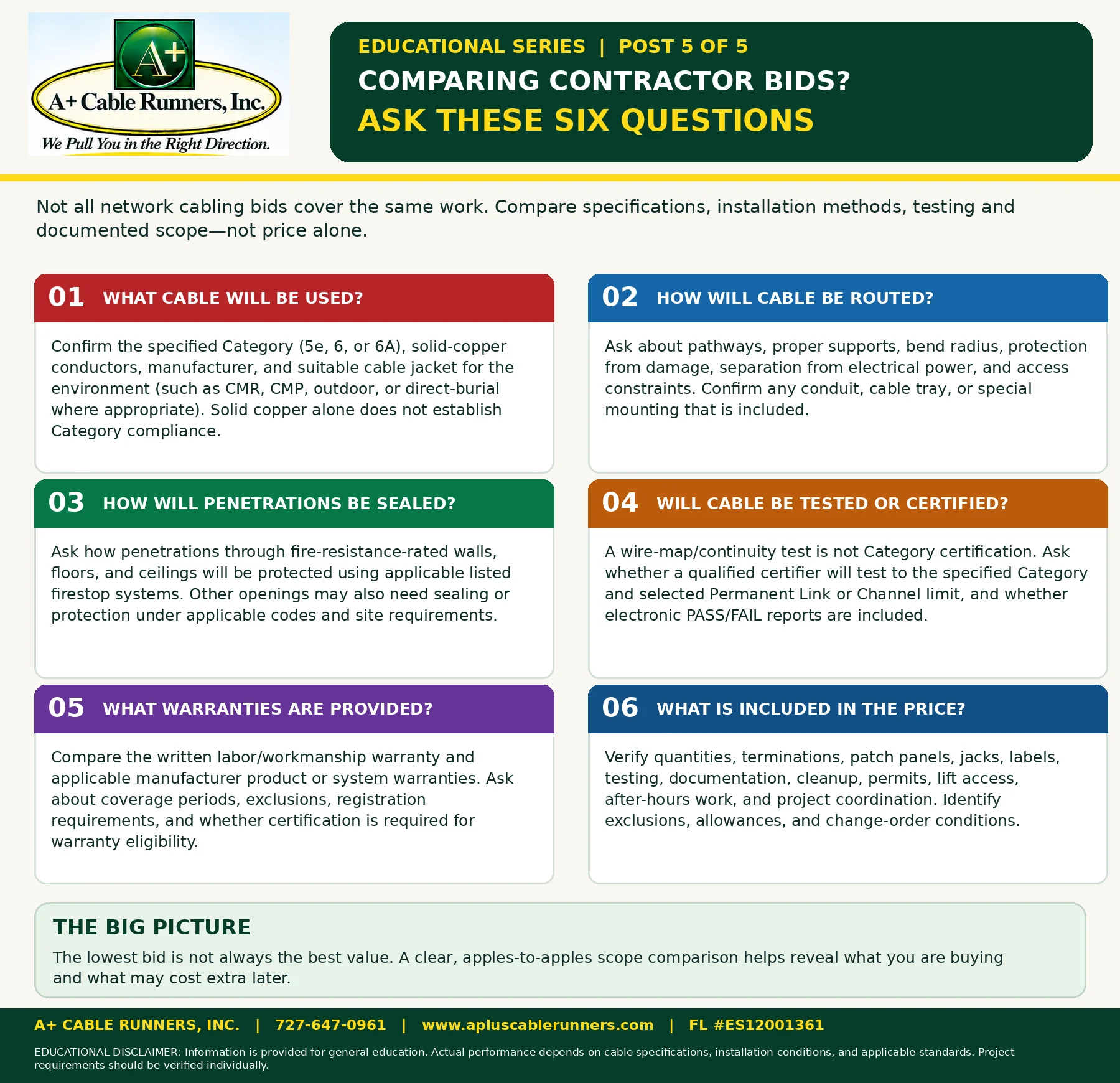
1. What cable will be used?
Confirm the category (Cat5e, Cat6 or Cat6A), solid-copper conductors, the manufacturer and a jacket rating suited to the space, such as CMR (riser), CMP (plenum), outdoor or direct-burial where appropriate. Copper-clad aluminum (CCA) does not meet the copper-conductor requirement of the Category standards, as post 2 explains. Solid copper alone does not establish Category compliance either: the installed cable still has to meet its category's performance requirements.
2. How will the cable be routed?
Ask about pathways, proper supports, bend radius, protection from damage, separation from electrical power and any access constraints. Confirm whether conduit, cable tray or special mounting is included. The National Electrical Code generally requires exposed communications cable to be supported by the building structure, not by the ceiling grid or tiles.
3. How will penetrations be sealed?
Where cable passes through fire-resistance-rated walls, floors or ceilings, the openings need to be protected with listed firestop systems so the assembly keeps its fire rating. Other openings may also need sealing or protection under the applicable codes and site requirements. If a job crosses rated walls and a bid never mentions firestopping, ask about it.
4. Will the cable be tested or certified?
A wire-map or continuity test is not Category certification. Ask whether a qualified certifier will test each run to the specified category and to a permanent link or channel limit, and whether electronic PASS/FAIL reports are included. Post 4 covers what certification measures and what a PASS does and does not mean.
5. What warranties are provided?
Compare the written labor (workmanship) warranty and any manufacturer product or system warranties. Ask about coverage periods, exclusions, registration requirements and whether certification is required for warranty eligibility. Fluke Networks notes that cabling manufacturers require certification testing to issue a warranty.
For reference, A+ Cable Runners warrants its labor for one year, and the equipment we install carries the manufacturer's warranty.
6. What is included in the price?
Verify quantities, terminations, patch panels, jacks, labels, testing, documentation, cleanup, permits, lift access, after-hours work and project coordination. Then identify the exclusions, the allowances and the conditions for change orders. The exclusions list is often where two bids really differ.
The big picture
The lowest bid is not always the best value. A clear, apples-to-apples comparison of scope shows what you are buying and what may cost extra later. To see the cabling work we do, visit our computer network cabling page.
Information is provided for general education. Actual performance depends on cable specifications, installation conditions and applicable standards. Project requirements should be verified individually.