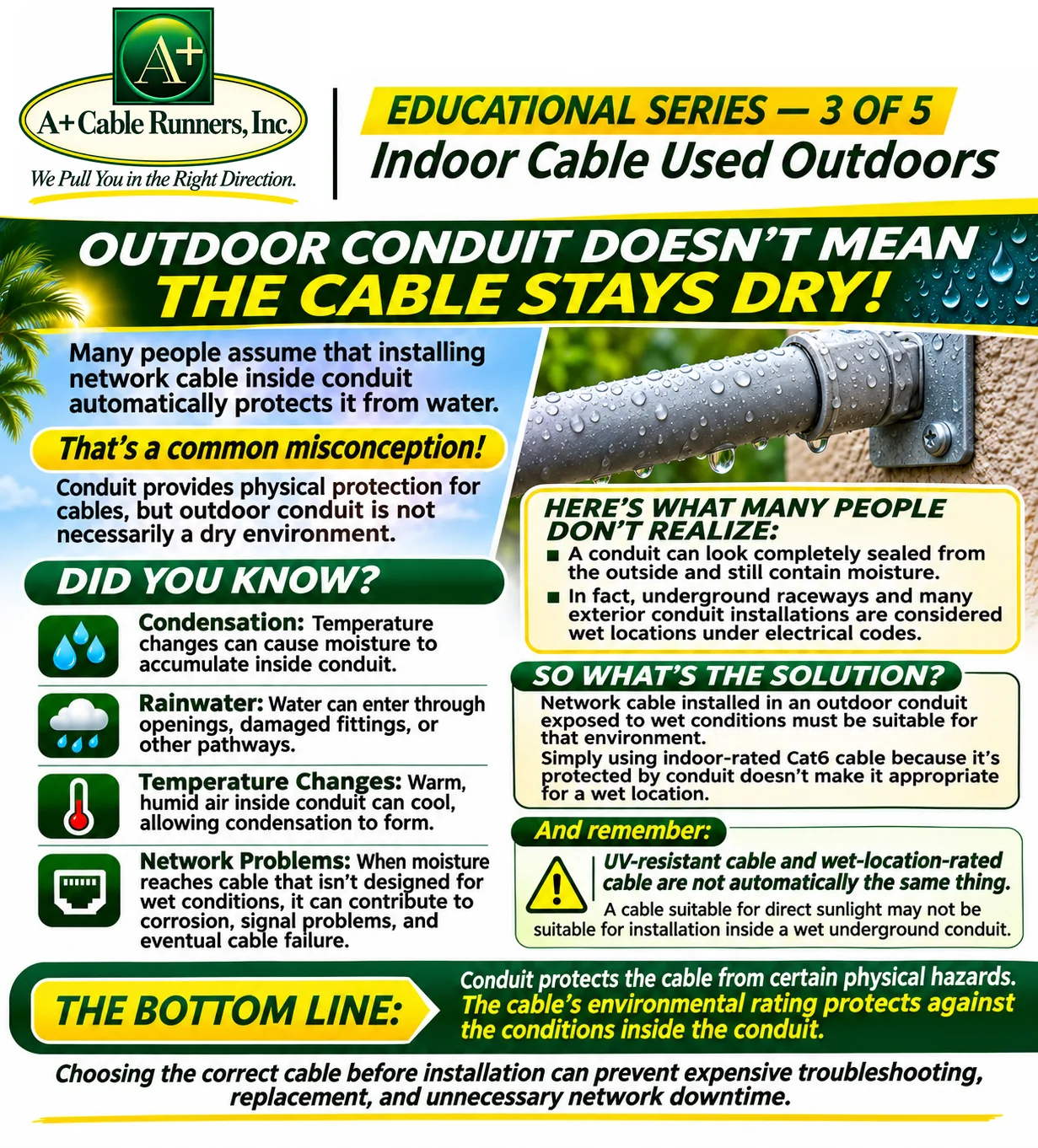
This is the third post in our five-part educational series, Indoor Cable Used Outdoors.
Many people assume that installing network cable inside conduit automatically protects it from water. That's a common misconception. Conduit provides physical protection for cables, but outdoor conduit is not necessarily a dry environment.
Did you know? How water gets into conduit
- Condensation. Temperature changes can cause moisture to accumulate inside conduit.
- Rainwater. Water can enter through openings, damaged fittings or other pathways.
- Temperature changes. Warm, humid air inside conduit can cool, allowing condensation to form.
- Network problems. When moisture reaches cable that isn't designed for wet conditions, it can contribute to corrosion, signal problems and eventual cable failure.
Condensation inside a raceway is a problem the electrical code already recognizes. The National Electrical Code says that where a raceway is exposed to different temperatures and condensation is known to be a problem, it must be sealed to keep warm air from circulating to a colder section. The 2026 edition also permits listed fittings designed to prevent warm-air movement and condensation, and requires raceways above ground in wet indoor locations to be arranged to drain.
Here's what many people don't realize
A conduit can look completely sealed from the outside and still contain moisture. In fact, underground raceways and many exterior conduit installations are considered wet locations under electrical codes. The National Electrical Code treats the interior of enclosures and raceways installed underground as a wet location (section 300.5(B)), and treats the interior of a raceway installed in a wet location above grade the same way (section 300.9 in the 2020 edition). Those sections sit in the code's general wiring rules. How they apply to a particular communications run is a design question, and the local inspector has the final word.
So what's the solution?
Network cable installed in an outdoor conduit exposed to wet conditions must be suitable for that environment. Simply using indoor-rated Cat6 cable because it's protected by conduit doesn't make it appropriate for a wet location.
The cable makers agree. A Superior Essex technical guideline on twisted-pair cable in below-grade conduit states that standard indoor CMR and CMP cables are not suitable for installation in wet locations, and that experience has shown conduit systems cannot be trusted to remain dry even after they have been dried out.
And remember: UV-resistant and wet-location-rated are not the same thing
A cable suitable for direct sunlight may not be suitable for installation inside a wet underground conduit. Belden, for example, defines its general outdoor-suitable cable as withstanding sunlight, moisture and occasional rain, and says that definition does not cover harsher exposure such as water immersion. Cable made for underground conduit is built differently. Superior Essex's outside plant cable surrounds the twisted pairs with a gel that repels water, and the manufacturer lists the conduit, duct and burial uses it is made for. Part two covered what the Florida sun does to the wrong cable; this is the other half of the same choice.
The bottom line
Conduit protects the cable from certain physical hazards. The cable's environmental rating protects against the conditions inside the conduit. Choosing the correct cable before installation can prevent expensive troubleshooting, replacement and unnecessary network downtime.
Our post on types of cable supports explains where conduit fits among cable pathways, and our post on fiber vs. copper between buildings covers the underground runs where this matters most. To see the cabling work we do, visit our computer network cabling page.
Next in the series, part four: The Cable Worked When Installed. So Why Is It Failing Now?
Information is provided for general education. It is not a substitute for project-specific design, engineering or manufacturer instructions. Always follow applicable codes and listed system requirements. Project requirements should be verified individually.