Looking for Fast, Reliable Fiber Connectivity?

We provide expert installation of fiber optic and Cat6A cabling to keep your systems fast, reliable, and up to code.
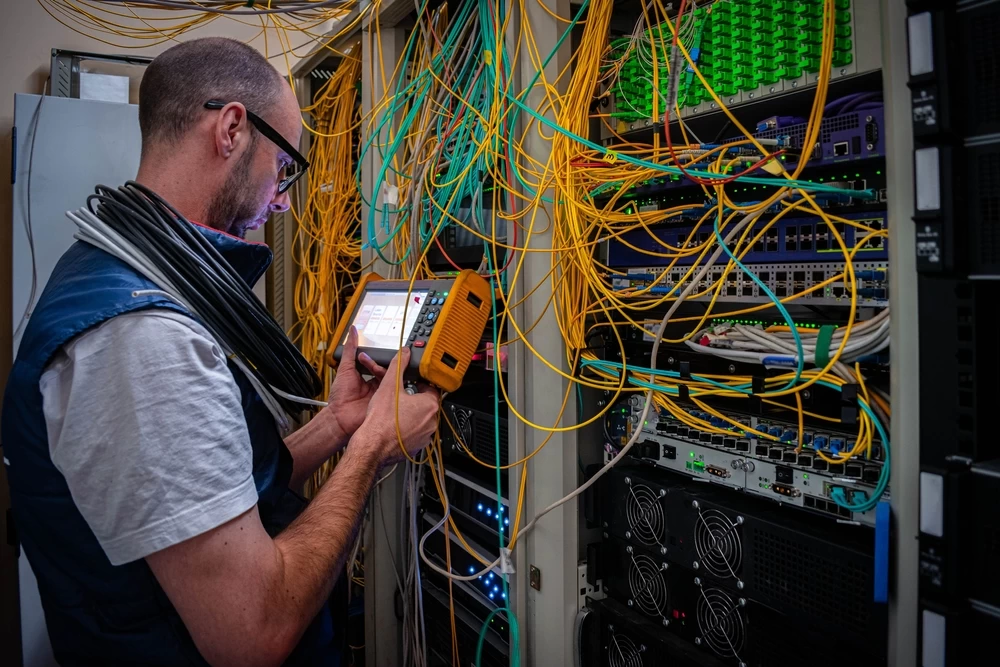

Technician testing fiber connections in a network rack

Your Cabling Should Be Fast, Tested, and Future-Ready

Unmatched Speed

Whether you're upgrading your infrastructure or building from scratch, we ensure your network is ready for growth.

Maximum Uptime

Our fiber and Cat6A testing process ensures your infrastructure delivers the speeds and performance your business depends on.

Future-Proof Connectivity

Your cabling system should evolve with your technology. We design and implement structured cabling that supports your current needs and scales easily as you grow.

Fiber Optic Cabling - High-Speed Connectivity

Speed Matters

Whether you’re transferring data, supporting high-speed communication, or preparing for future growth, you need fiber optic cabling that delivers. We understand that lag, slow speeds, and unreliable connectivity are simply not an option.

Connectivity That Won’t Slow You Down

Our team deploys industry-leading fiber optic cabling solutions that provide superior speed, efficiency, and durability. From large-scale enterprise installations to high-demand IT environments, we ensure that your business stays ahead with cutting-edge connectivity that won’t slow you down.

Fiber that is specified, installed and tested

Fiber optic cable carries your network where copper cannot: between network closets, up through the floors of a building and across a property to other buildings. Copper Ethernet is designed for runs of up to 100 meters, about 328 feet, including the patch cords. Fiber goes much farther.

Single-mode and multimode

Multimode fiber is common inside buildings: 10-gigabit equipment is rated for about 300 meters on OM3 multimode fiber and about 400 meters on OM4. Single-mode fiber covers longer distances, up to 10 kilometers for common 10-gigabit equipment. Which one fits depends on the distances involved, the equipment at each end and how much the network will grow.

Between buildings

All-dielectric fiber cable, with no metal in it, does not conduct electricity, so it does not create an electrical path between two buildings with separate grounds. That makes it the safer way to connect a warehouse, a second office or a guard shack to your main network. Fiber cables with metal armor or metal strength members are different: their metal parts must be grounded, or interrupted with an insulating joint, close to where the cable enters each building.

Cat6A for high-speed copper runs

Where a copper run is the right answer but needs 10-gigabit speed over the full 100 meters, Cat6A is the cable for it. Read our Cat6 vs. Cat6A guide.

Tested, with results you can keep

We test fiber and Cat6A infrastructure for speed, integrity, signal loss and compliance with industry standards, on new installations and on existing networks, so you have verified results rather than guesses.

Selected projects

  • Sheraton Sand Key Resort, Clearwater Beach: a new 6-strand single-mode fiber optic backbone, installed with structured cabling throughout the floors during the resort's remodel.
  • KnowBe4, Clearwater: OM4 multimode fiber optic infrastructure between floors, with structured cabling across four floors.
  • ZooTampa at Lowry Park, Tampa: fiber optic and structured network cabling, plus Verkada security cameras and access control infrastructure.

Fiber Optics for Unmatched Speed.

1.

Schedule Your Testing Service

Book a visit from our certified cable testing specialists. We’ll come on-site to inspect and test your fiber or Cat6A network infrastructure.

2.

Conduct Certified Testing

Using advanced tools, we run a full range of tests to check speed, integrity, signal loss, and compliance with industry standards. No guessing—just verified results.

3.

Report & Troubleshoot Issues

We provide a detailed report of your system’s performance. If anything fails or falls short, we pinpoint the issue and offer immediate solutions for optimization.

4.

Ensure Peak Connectivity

With a certified cable network, your systems run at maximum performance. You’ll eliminate downtime risks and gain confidence in the reliability of your entire infrastructure.

FAQ

Fiber carries data much farther than copper, which is limited to runs of about 100 meters, and it supports very high speeds. All-dielectric fiber cable, with no metal in it, also does not conduct electricity, which makes it the safer link between buildings. Copper is still the usual choice for desk connections and for devices that take their power over the cable.

Businesses with several network closets, floors or buildings often link them with fiber, and any connection longer than about 100 meters needs it. Our fiber work includes a resort, four floors of an office building and a zoo.

Yes. We test existing fiber and Cat6A infrastructure for speed, integrity, signal loss and compliance with industry standards, and repair what the testing finds.

That depends on the fiber type, the distance and the equipment at each end, not just the cable. Common 10-gigabit equipment runs about 300 meters on OM3 multimode fiber, about 400 meters on OM4, and up to 10 kilometers on single-mode. Faster equipment is available too, though on multimode fiber it reaches shorter distances.

Yes. Fiber carries whatever the network carries, including phone calls and video from security cameras. It usually links network closets and buildings, while copper cable runs the last stretch to each phone or camera, often carrying its power too.