This is the twelfth post in our Commercial Property Management educational series.
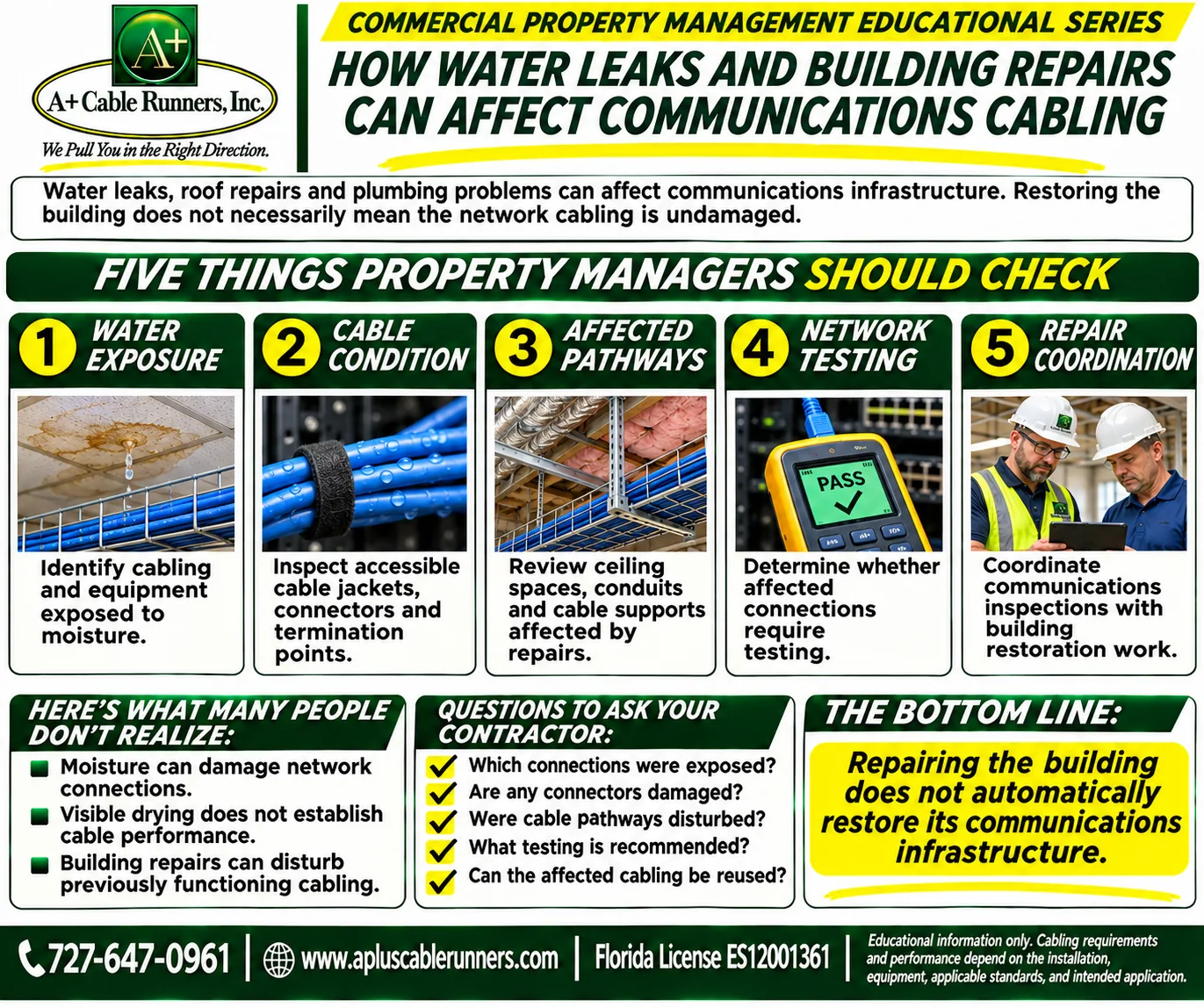
Water leaks, roof repairs and plumbing problems can affect communications infrastructure. Restoring the building does not necessarily mean the network cabling is undamaged. Here are five things property managers should check.
1. Water exposure
Identify cabling and equipment exposed to moisture.
Look beyond the area directly under the stain on the tile. Check the cable runs, jacks, patch panels and equipment along the path the water may have taken.
2. Cable condition
Inspect accessible cable jackets, connectors and termination points.
Look at the connectors and terminations, not only the jacket. Indoor-rated network cable is not necessarily designed for wet conditions; our post on indoor network cable used outdoors explains why.
3. Affected pathways
Review ceiling spaces, conduits and cable supports affected by repairs.
Roofers, plumbers and drywall crews work in the same ceiling space as the cabling. The National Electrical Code expects exposed communications cable to be supported by the structural components of the building so normal building use doesn't damage it (800.24 in the 2023 edition), and it does not allow the ceiling grid or its support wires to be used as cable support. A support that was moved, cut or removed during a repair may leave cable resting on the ceiling grid or on pipes. An informational note to that section also cautions that paint, plaster, cleaners, abrasives, corrosive residues and other contaminants may alter cable properties, which is worth keeping in mind after drywall and painting work overhead.
4. Network testing
Determine whether affected connections require testing.
A basic verification test shows whether a cable is connected correctly. Certification measures it against the performance standard for its category. Which one makes sense depends on what was exposed and what the connection needs to carry. Our post on cable testing versus certification explains what a PASS does and does not tell you.
5. Repair coordination
Coordinate communications inspections with building restoration work.
The easiest time to look at cabling is while the ceiling is open and the restoration crew is still on site, not after the tiles are back and a tenant starts reporting dropped connections.
Here's what many people don't realize
- Moisture can damage network connections.
- Visible drying does not establish cable performance.
- Building repairs can disturb previously functioning cabling.
Questions to ask your contractor
- Which connections were exposed?
- Are any connectors damaged?
- Were cable pathways disturbed?
- What testing is recommended?
- Can the affected cabling be reused?
If the answer to the last question is no, our earlier post on the difference between repairing cabling and replacing it covers how to decide what to do next.
The bottom line
Repairing the building does not automatically restore its communications infrastructure.
The next post in the series covers why abandoned cabling deserves attention during renovations. To see the cabling work we do, visit our computer network cabling page.
Educational information only. Cabling requirements and performance depend on the installation, equipment, applicable standards and intended application. This is not a substitute for project-specific design or engineering. Always follow applicable codes and manufacturer instructions, and verify project requirements individually.