This post goes with post 4 of our five-part educational series on network cable. Post 3 covered why cable matters for Power over Ethernet.
The cabling went in, every run got a green light on the tester and the crew went home. Later, a camera keeps dropping offline and one office has slow connections. The cable "passed," so it gets ruled out first. That can be a mistake, because a basic cable test and a cable certification answer different questions.
What a basic test does
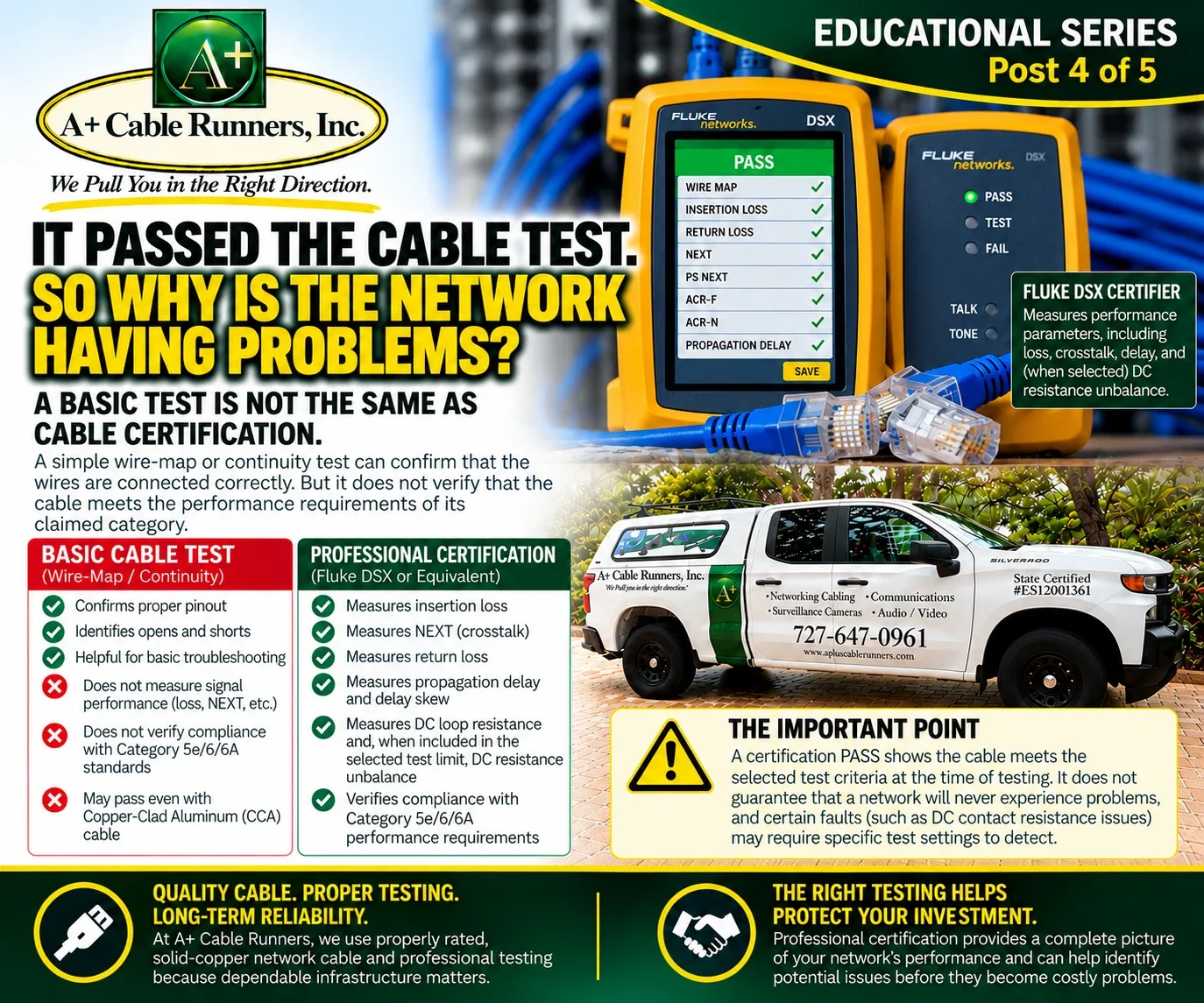
A simple wire-map or continuity tester confirms that the wires are connected correctly. It is a useful tool:
- It confirms the pinout, meaning each wire lands on the right pin at both ends.
- It identifies opens and shorts.
- It is a good first step when troubleshooting a dead jack.
What it does not do:
- Measure signal performance, such as loss and crosstalk.
- Verify compliance with Category 5e, 6 or 6A standards.
- Tell you what the conductors are made of. A wire-map test checks connections, so copper-clad aluminum (CCA) cable can pass one.
Fluke Networks, which makes cable test equipment, calls this level verification, and says verification testing alone will not show that cabling can support specific applications or establish the standards compliance a manufacturer warranty requires.
What certification measures
A certification tester, such as Fluke's DSX series or equivalent, measures the installed link across set frequency ranges and compares the results with the TIA or ISO limits for its category. Fluke's datasheet for the DSX-5000 lists measurements including:
- Insertion loss: how much signal is lost along the run.
- Near-end crosstalk (NEXT): how much signal from one pair leaks into another.
- Return loss: how much signal reflects back from imperfections in the cable or its connections.
- Propagation delay and delay skew: how long the signal takes to arrive, and how much the four pairs differ.
- DC loop resistance. The datasheet also notes support for the resistance unbalance standards used for Power over Ethernet, and that the test standard selected determines which measurements run.
The result is a pass or fail for each run against the Category 5e, 6 or 6A performance requirements. Fluke also notes that cabling manufacturers require certification to issue a warranty, and prefers testing the permanent link, the fixed cable from the closet patch panel to the work area jack, as the best way to confirm performance at installation.
The important point
A cable can be wired correctly and still fall short of the performance requirements of its category. A basic test cannot show the difference. Certification can.
A certification PASS has limits too. It shows the cable met the selected test criteria at the time it was tested. It does not guarantee that a network will never have problems, and some faults, such as poor contacts that add DC resistance, may only show up when the tester is set up to look for them. That is why it helps to know which test limit was used, not just that the run passed.
What to ask for
- How will each run be tested: wire map or certification?
- Which tester, and against which category and test limit?
- Will I receive the results for every run?
At A+ Cable Runners, we use properly rated, solid-copper network cable and professional testing because dependable infrastructure matters. To see the cabling work we do, visit our computer network cabling page.