This is the ninth post in our Commercial Property Management educational series.
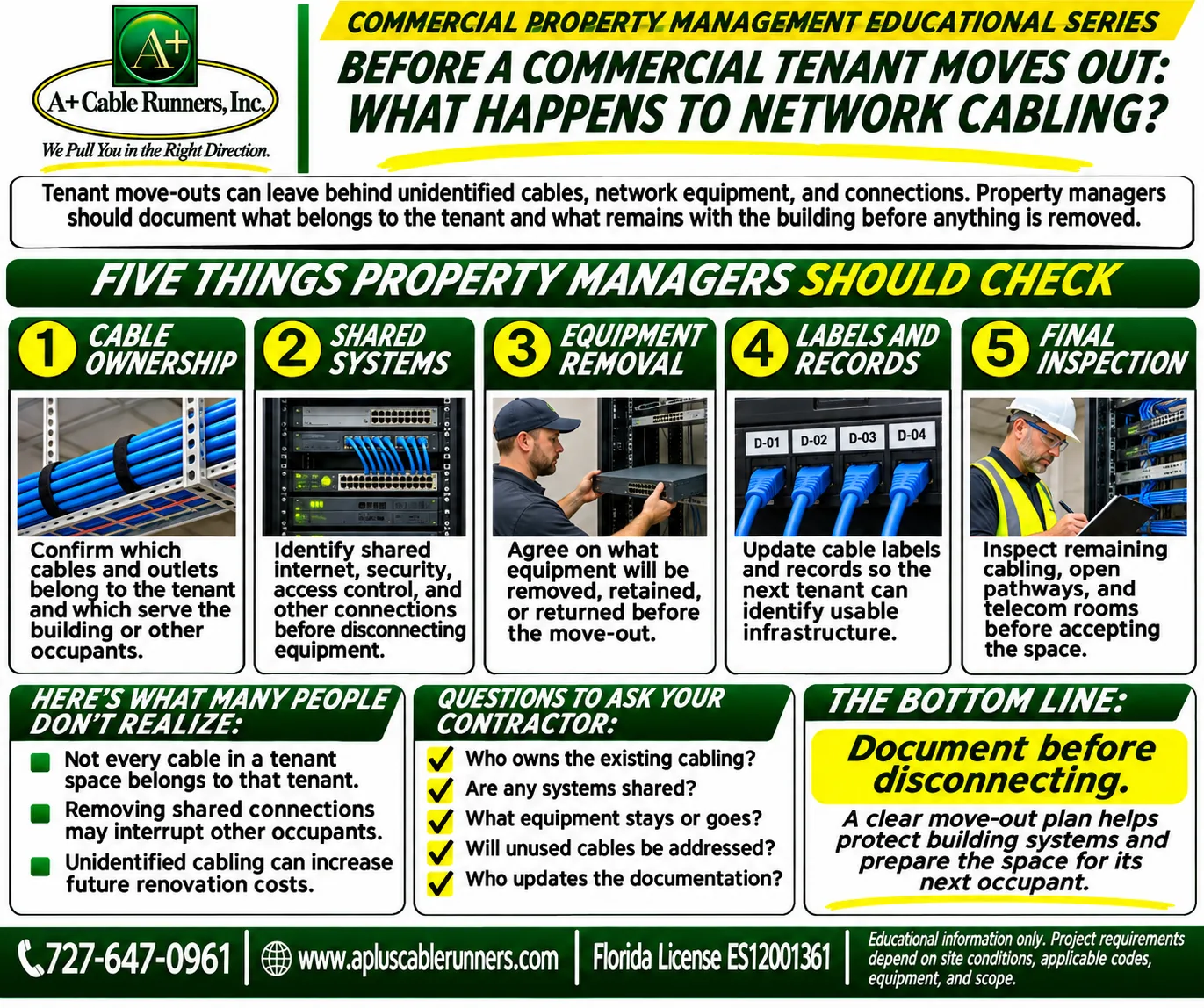
Tenant move-outs can leave behind unidentified cables, network equipment and connections. Property managers should document what belongs to the tenant and what remains with the building before anything is removed. Here are five things to check.
1. Cable ownership
- Confirm which cables and outlets belong to the tenant and which serve the building or other occupants.
2. Shared systems
- Identify shared internet, security, access control and other connections before disconnecting equipment.
3. Equipment removal
- Agree on what equipment will be removed, retained or returned before the move-out.
4. Labels and records
- Update cable labels and records so the next tenant can identify usable infrastructure.
TIA-606, the industry standard for administering cabling, covers assigning identifiers to cables, pathways and spaces and keeping a record for each one. Our post on what a messy network closet is really costing you covers what labeling a closet involves.
5. Final inspection
- Inspect remaining cabling, open pathways and telecom rooms before accepting the space.
Here's what many people don't realize
- Not every cable in a tenant space belongs to that tenant.
- Removing shared connections may interrupt other occupants.
- Unidentified cabling can increase future renovation costs.
Cable left behind is also a code question. The National Electrical Code treats communications cable that is not terminated and not identified for future use as abandoned, and requires the accessible portion of it to be removed. Deciding at move-out which runs will be reused, identified for future use or removed keeps that from piling up above the ceiling.
Questions to ask your contractor
- Who owns the existing cabling?
- Are any systems shared?
- What equipment stays or goes?
- Will unused cables be addressed?
- Who updates the documentation?
The bottom line
Document before disconnecting. A clear move-out plan helps protect building systems and prepare the space for its next occupant. When the next tenant is lined up, our post on what to check before converting office space for a new tenant picks up from there.
The next post in the series covers who handles low-voltage work during a tenant build-out. To see the cabling work we do, visit our computer network cabling page.
Educational information only. Cabling requirements and performance depend on the installation, equipment, applicable standards and intended application. This is not a substitute for project-specific design or engineering. Always follow applicable codes and manufacturer instructions, and verify project requirements individually.