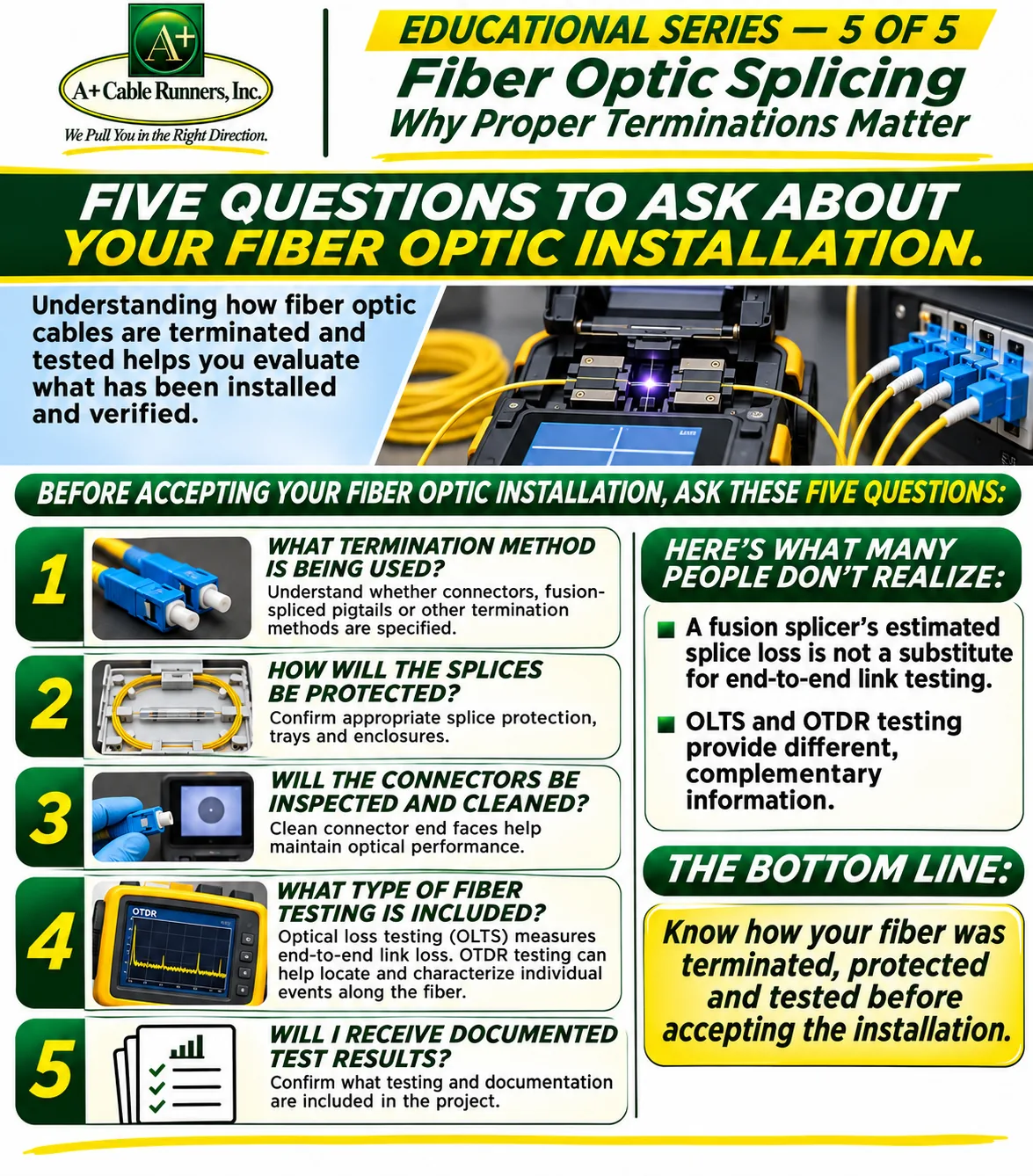
This is the fifth post in our five-part Fiber Optic Splicing: Why Proper Terminations Matter educational series.
Understanding how fiber optic cables are terminated and tested helps you evaluate what has been installed and verified. Before accepting your fiber optic installation, ask these five questions.
1. What termination method is being used?
Understand whether connectors, fusion-spliced pigtails or other termination methods are specified. According to the Fiber Optic Association (FOA), most field single-mode terminations are made by splicing a factory-made pigtail onto the cable.
2. How will the splices be protected?
Confirm appropriate splice protection, trays and enclosures. A finished fusion splice gets a permanent splice protector, then goes into a splice tray inside a closure or enclosure. Part three of this series covers what makes a good splice, from stripping to protection.
3. Will the connectors be inspected and cleaned?
Clean connector end faces help maintain optical performance. Fluke Networks advises inspecting every connector end face before connecting it, and inspecting again after cleaning.
4. What type of fiber testing is included?
Optical loss testing (OLTS) measures end-to-end link loss. OTDR testing can help locate and characterize individual events along the fiber.
An optical loss test set is a light source at one end and a power meter at the other, standing in for the equipment that will use the link. An OTDR (optical time domain reflectometer) works from one end, reading the light that comes back, and shows events such as splices, connectors, stress or breaks in the fiber along a distance scale. The FOA notes that measuring the loss of a link is better left to a test source and power meter, and that many international standards do not allow using only an OTDR to measure the loss of an installed cable plant.
5. Will I receive documented test results?
Confirm what testing and documentation are included in the project. Test results recorded at installation give you a baseline to compare against if a problem shows up later. The FOA notes that having the original OTDR trace from installation makes later trace analysis easier.
Here's what many people don't realize
- A fusion splicer's estimated splice loss is not a substitute for end-to-end link testing.
- OLTS and OTDR testing provide different, complementary information.
The FOA's fusion splicing guide notes that the splicer will give an estimate of the splice loss, but that the only way to test the splice is with an OTDR, and that testing may be needed from both directions because OTDRs have directional errors.
The bottom line
Know how your fiber was terminated, protected and tested before accepting the installation.
That wraps up our Fiber Optic Splicing series. Start from the beginning with What Is Fiber Optic Splicing, and Why Does It Matter? For the copper side of the same question, see our series that begins with a network cable that works, but was it tested? To see the fiber work we do, visit our fiber optic cabling page.
Educational information only. Cabling requirements and performance depend on the installation, equipment, applicable standards and intended application. This is not a substitute for project-specific design or engineering. Always follow applicable codes and manufacturer instructions, and verify project requirements individually.