This is the third post in our five-part Fiber Optic Splicing: Why Proper Terminations Matter educational series.
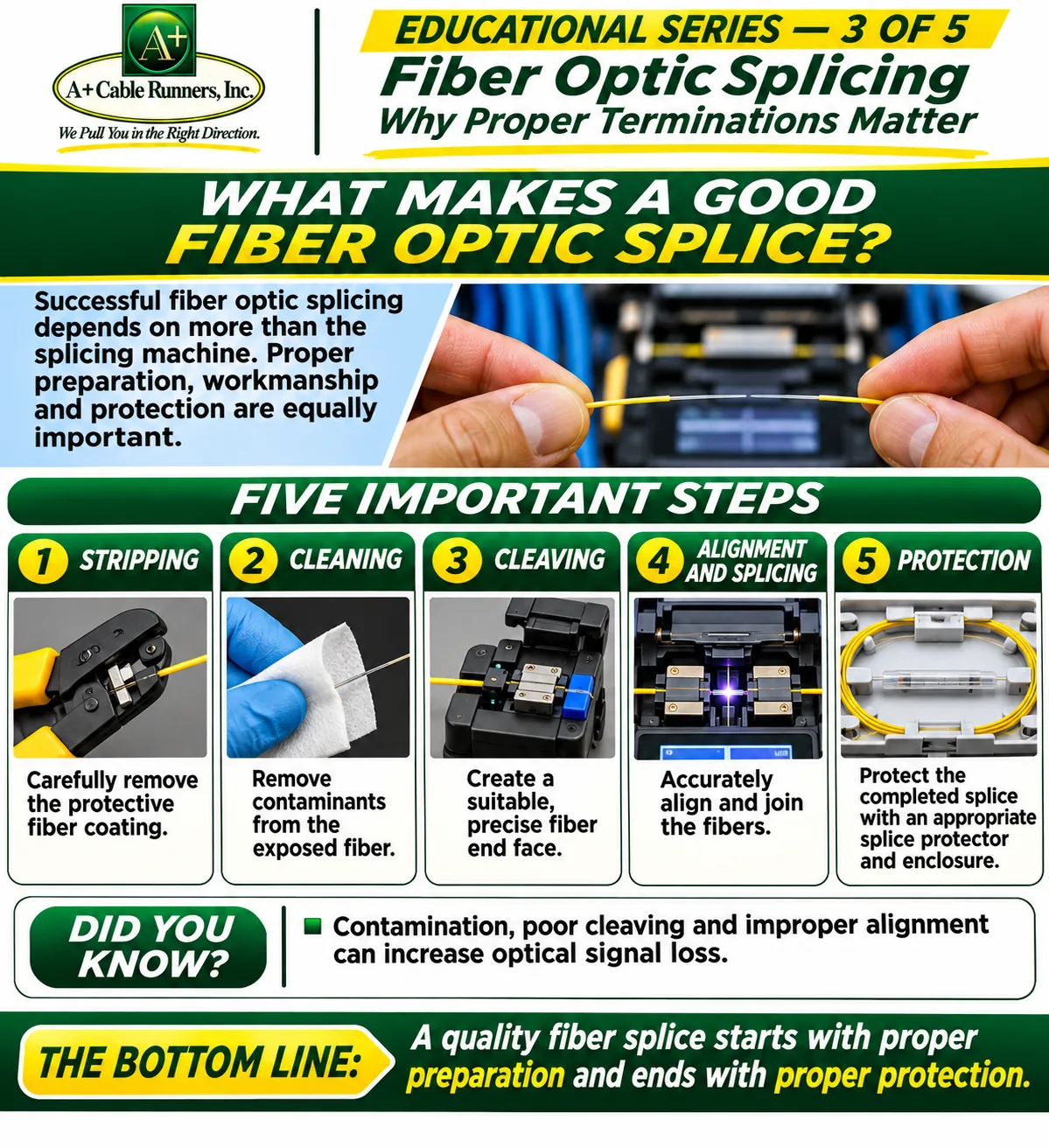
Successful fiber optic splicing depends on more than the splicing machine. Proper preparation, workmanship and protection are equally important. Here are five important steps.
1. Stripping
Carefully remove the protective fiber coating. The bare glass underneath is what gets spliced. The Fiber Optic Association (FOA) notes that fusion splicing requires stripping a longer length of bare fiber than connector termination does, so the choice of stripper matters.
2. Cleaning
Remove contaminants from the exposed fiber. Any residue left on the glass can end up in the splice. The FOA's fusion splicing guide stresses that each fiber must be cleaned thoroughly.
3. Cleaving
Create a suitable, precise fiber end face. The cleave creates the end face that will meet the other fiber. The FOA notes that the quality of a fusion splice depends on the quality of the cleave, and calls cleaving the most important step in mechanical splicing.
4. Alignment and splicing
Accurately align and join the fibers. In fusion splicing, the machine lines up the two prepared ends and fuses them with an automatic arc cycle. In mechanical splicing, an alignment fixture holds the ends together. Part two of this series covers the difference between the two methods.
5. Protection
Protect the completed splice with an appropriate splice protector and enclosure. Once the coating is stripped away, the bare joint is fragile. The FOA describes attaching a permanent splice protector, by heat-shrinking or clamping, then placing the spliced fibers in a splice tray that goes into a splice closure.
Did you know? Small mistakes add loss
Contamination, poor cleaving and improper alignment can increase optical signal loss. None of these is visible to the naked eye once the splice is sleeved and put away, which is why testing the finished link matters. Part five of this series covers what testing to ask for.
The bottom line
A quality fiber splice starts with proper preparation and ends with proper protection.
Next in the series, part four: Why Poor Fiber Optic Terminations Can Cause Network Problems. To see the fiber work we do, visit our fiber optic cabling page.
Educational information only. Cabling requirements and performance depend on the installation, equipment, applicable standards and intended application. This is not a substitute for project-specific design or engineering. Always follow applicable codes and manufacturer instructions, and verify project requirements individually.