This is the fourth post in our five-part Fiber Optic Splicing: Why Proper Terminations Matter educational series.
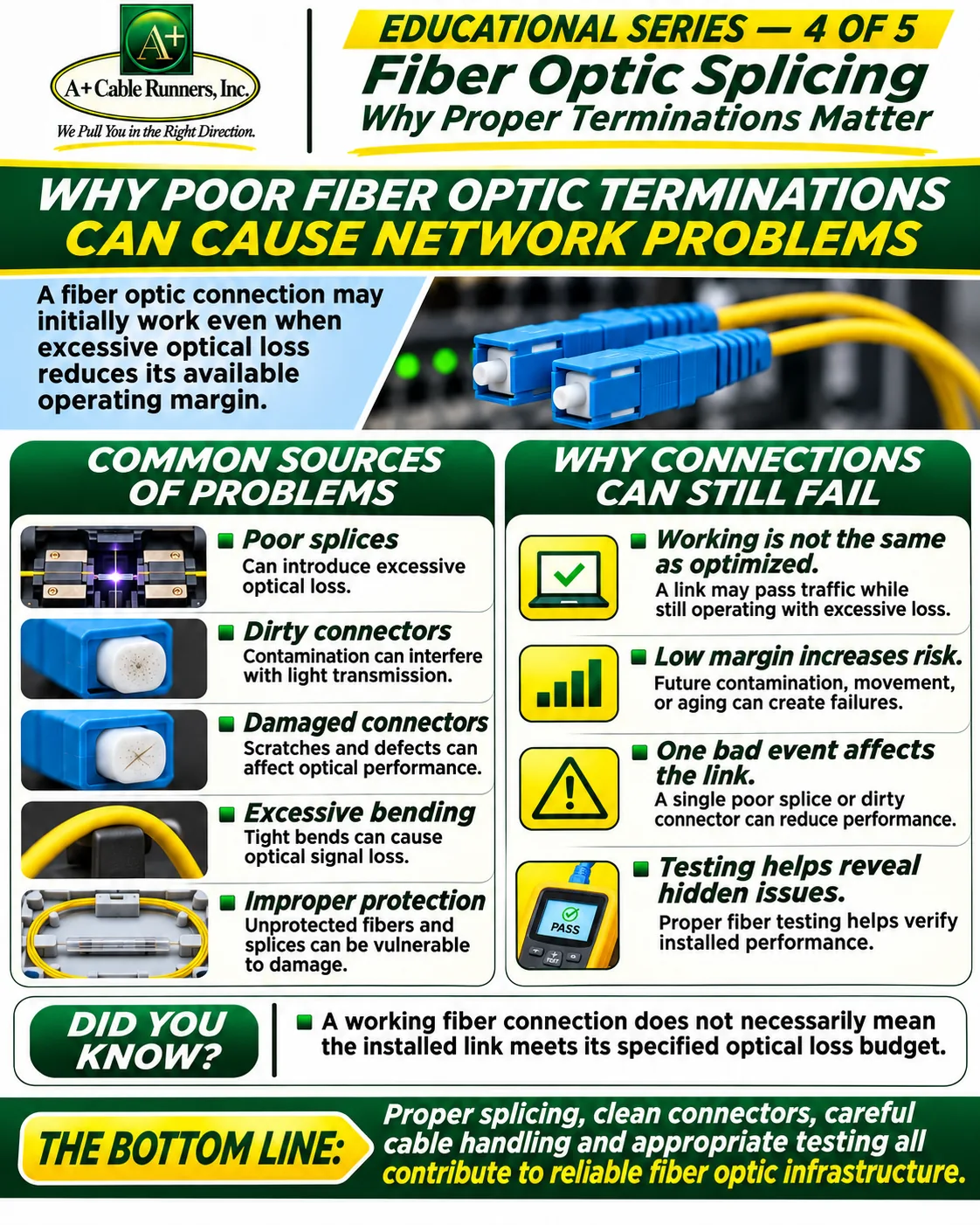
A fiber optic connection may initially work even when excessive optical loss reduces its available operating margin. That is what makes a poor termination easy to miss: the lights come on, data moves, and the problem waits.
Common sources of problems
- Poor splices. They can introduce excessive optical loss.
- Dirty connectors. Contamination can interfere with light transmission.
- Damaged connectors. Scratches and defects can affect optical performance.
- Excessive bending. Tight bends can cause optical signal loss.
- Improper protection. Unprotected fibers and splices can be vulnerable to damage.
Dirt deserves special mention. Fluke Networks, a maker of cable test equipment, states that contaminated connections remain the number one cause of fiber related problems and test failures. Its advice is to inspect every connector end face before connecting it, and because the act of cleaning can itself leave contamination behind, to inspect, clean and inspect again.
Why connections can still fail
- Working is not the same as optimized. A link may pass traffic while still operating with excessive loss.
- Low margin increases risk. Future contamination, movement or aging can create failures.
- One bad event affects the link. A single poor splice or dirty connector can reduce performance.
- Testing helps reveal hidden issues. Proper fiber testing helps verify installed performance.
The Fiber Optic Association (FOA) recommends that a link's loss margin be greater than about 3 dB to allow for degradation over time, and notes that some high-speed multimode links have a power budget of only about 2 dB. On a link like that, one poor splice or one dirty connector can use up much of what the equipment can tolerate.
Did you know? Working is not the same as within budget
A working fiber connection does not necessarily mean the installed link meets its specified optical loss budget. The FOA describes the loss budget as the amount of loss a cable plant should have if it is installed properly, and notes that it is compared against test results after installation. As the FOA's loss budget guide also notes, the TIA-568 standard allows a maximum of 0.3 dB per splice and 0.75 dB per mated connector pair. The only way to know where a link stands is to measure it.
Copper cabling has the same gap between "it works" and "it meets the standard." Our post on cable testing versus certification explains it for network cable.
The bottom line
Proper splicing, clean connectors, careful cable handling and appropriate testing all contribute to reliable fiber optic infrastructure.
Next in the series, part five: Five Questions to Ask About Your Fiber Optic Installation. To see the fiber work we do, visit our fiber optic cabling page.
Educational information only. Cabling requirements and performance depend on the installation, equipment, applicable standards and intended application. This is not a substitute for project-specific design or engineering. Always follow applicable codes and manufacturer instructions, and verify project requirements individually.