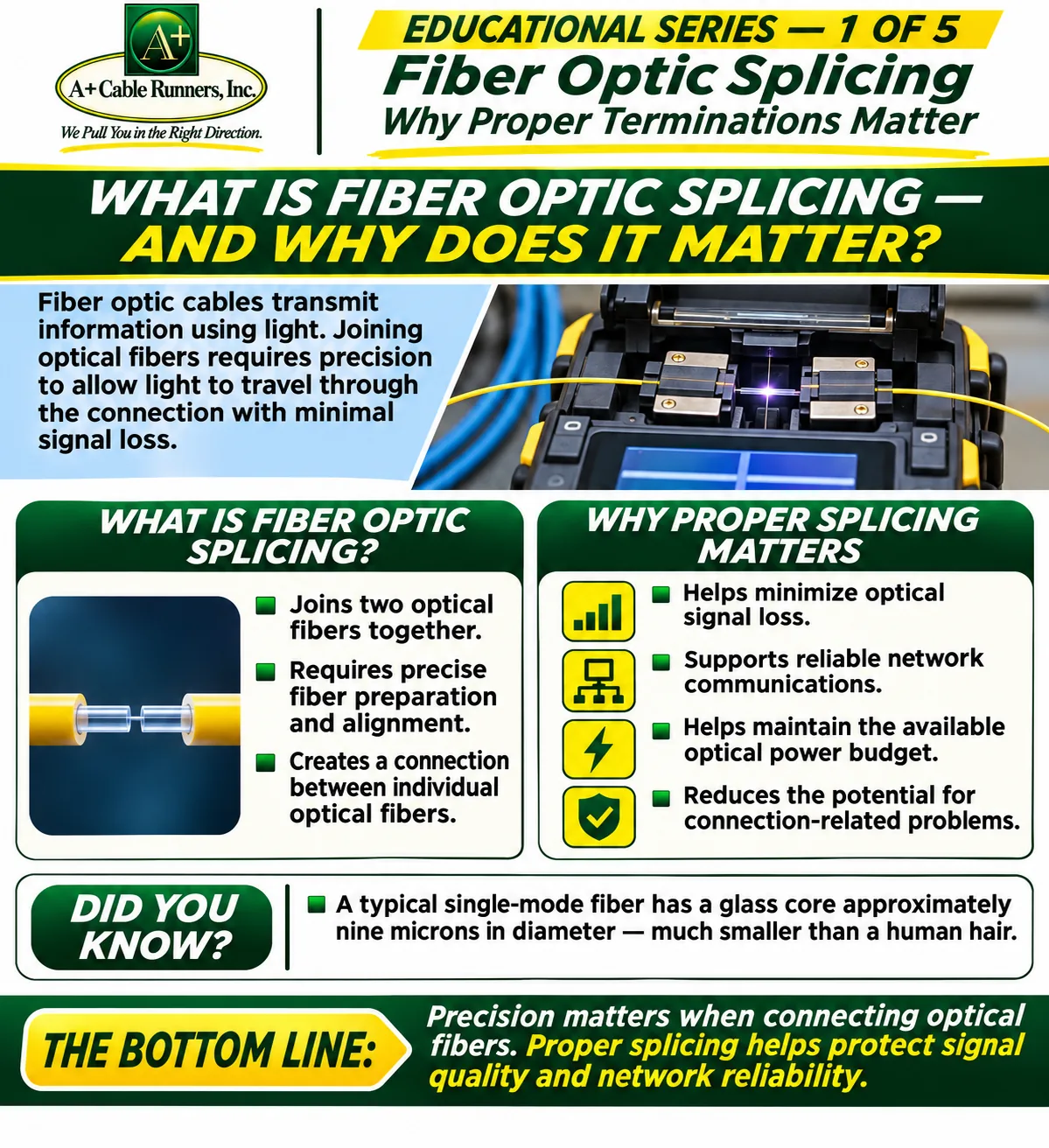
This is the first post in our five-part Fiber Optic Splicing: Why Proper Terminations Matter educational series.
Fiber optic cables transmit information using light. Joining optical fibers requires precision to allow light to travel through the connection with minimal signal loss. Whether fiber links two floors, two buildings or a network closet to a remote camera, every place one fiber meets another is a point where that precision counts.
What is fiber optic splicing?
- It joins two optical fibers together.
- It requires precise fiber preparation and alignment.
- It creates a connection between individual optical fibers.
Unlike a connector, which can be unplugged and plugged back in, a splice is meant to be a permanent joint. Splicing is used to join cable segments into a longer run, to restore damaged cable, and to terminate cable: according to the Fiber Optic Association, most field single-mode terminations are made by splicing a factory-made connector tail, called a pigtail, onto the cable. The most widely used method, fusion splicing, welds the two fibers together, usually with an electric arc. Part two of this series compares it with mechanical splicing.
Why proper splicing matters
- It helps minimize optical signal loss.
- It supports reliable network communications.
- It helps maintain the available optical power budget.
- It reduces the potential for connection-related problems.
A fiber link only works if the total loss in the cable plant stays within what the equipment at each end can handle, its power budget. Every splice and every connector adds some loss. The Fiber Optic Association describes a loss budget as the amount of loss a cable plant should have if it is installed properly, worked out by adding up the expected losses of its parts. A well-made splice uses very little of that budget. A poor one uses more than its share and leaves less room for everything else.
Did you know? The glass is tiny
A typical single-mode fiber has a glass core approximately nine microns in diameter, much smaller than a human hair. The Fiber Optic Association puts single-mode core size at about 9 microns, and the whole fiber, glass cladding included, at 125 microns in outside diameter, which it describes as a bit larger than a typical human hair. Lining up two cores that small, end to end, is why splicing takes specialized tools and careful hands.
Single-mode is the fiber usually used for longer distances. Multimode fiber has a larger core, but the same principle applies: the ends have to be prepared and aligned precisely. For when fiber is the right choice between buildings, see our post on fiber vs. copper between buildings.
The bottom line
Precision matters when connecting optical fibers. Proper splicing helps protect signal quality and network reliability.
Next in the series, part two: Fusion Splicing vs. Mechanical Splicing: What's the Difference? To see the fiber work we do, visit our fiber optic cabling page.
Educational information only. Cabling requirements and performance depend on the installation, equipment, applicable standards and intended application. This is not a substitute for project-specific design or engineering. Always follow applicable codes and manufacturer instructions, and verify project requirements individually.