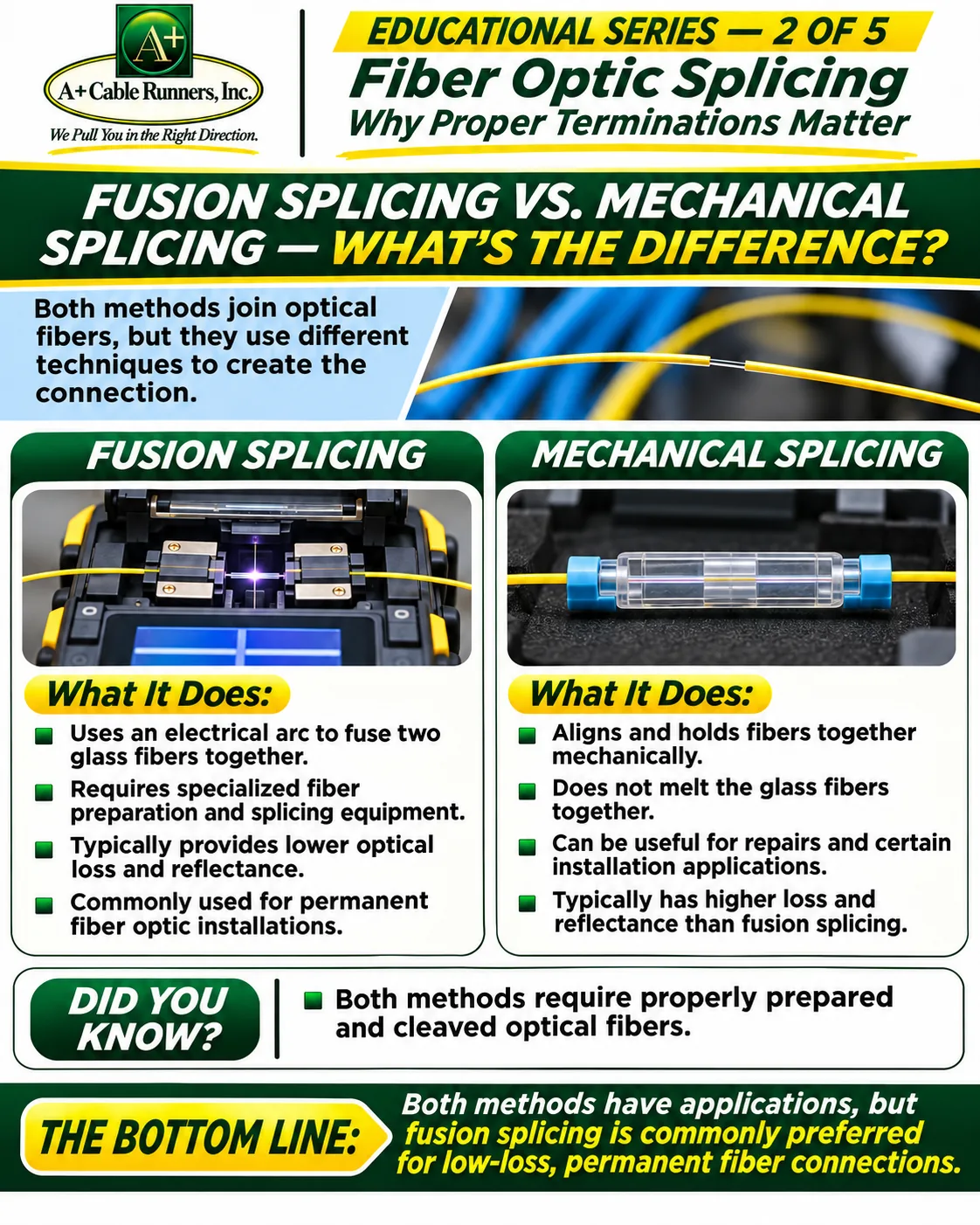
This is the second post in our five-part Fiber Optic Splicing: Why Proper Terminations Matter educational series.
Both fusion splicing and mechanical splicing join optical fibers, but they use different techniques to create the connection. Knowing which one is planned for your project, and why, helps you understand what you are getting.
Fusion splicing
- Uses an electrical arc to fuse two glass fibers together.
- Requires specialized fiber preparation and splicing equipment.
- Typically provides lower optical loss and reflectance.
- Commonly used for permanent fiber optic installations.
The Fiber Optic Association (FOA) describes fusion splicing as fusing or welding two fibers together, usually with an electric arc, and says it provides the lowest loss and least reflectance, as well as the strongest and most reliable joint between two fibers.
Mechanical splicing
- Aligns and holds fibers together mechanically.
- Does not melt the glass fibers together.
- Can be useful for repairs and certain installation applications.
- Typically has higher loss and reflectance than fusion splicing.
A mechanical splice holds the two fiber ends in an alignment fixture, with a clear gel or optical adhesive between them that reduces loss and reflectance. According to the FOA, mechanical splices are most popular for fast, temporary restoration and are also used for most multimode splicing in premises installations. Their main advantage is that they do not need an expensive splicing machine.
Why loss and reflectance matter
Loss is light that does not make it through the joint. Reflectance is light that bounces back toward the source. Both count against the link. The industry standard for commercial cabling, TIA-568, allows a maximum of 0.3 dB per splice, as the FOA's guide to loss budgets notes. A well-made fusion splice should come in well under that limit, which leaves more of the link's budget for connectors, cable length and future changes. Part one of this series explains why that budget matters.
Did you know? Preparation comes first either way
Both methods require properly prepared and cleaved optical fibers. The FOA calls cleaving the most important step in mechanical splicing, and notes that the quality of a fusion splice depends on the quality of the cleave. Part three of this series walks through the preparation steps.
The bottom line
Both methods have applications, but fusion splicing is commonly preferred for low-loss, permanent fiber connections.
Next in the series, part three: What Makes a Good Fiber Optic Splice? To see the fiber work we do, visit our fiber optic cabling page.
Educational information only. Cabling requirements and performance depend on the installation, equipment, applicable standards and intended application. This is not a substitute for project-specific design or engineering. Always follow applicable codes and manufacturer instructions, and verify project requirements individually.