This is the final post in our five-part educational series on RJ45 connectors and keystone jacks.
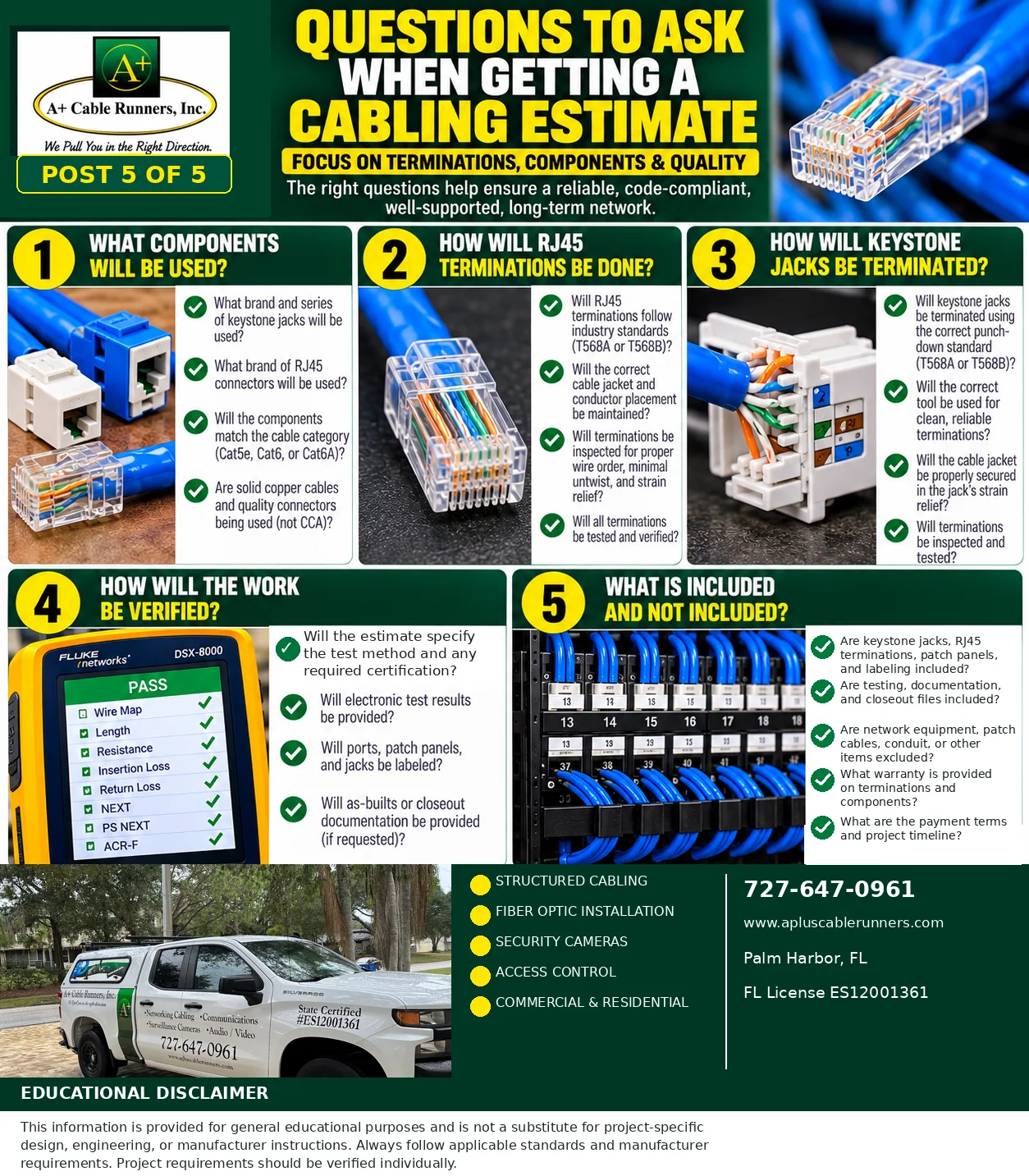
Most cabling estimates list the number of drops, the cable and a price. The details that decide how reliable the network will be, which connectors and jacks are used, how they are terminated and how the work is verified, are often left out. The right questions help ensure a reliable, code-compliant, well-supported network that lasts. Here are the ones to ask, focused on terminations, components and quality.
1. What components will be used?
- What brand and series of keystone jacks will be used?
- What brand of RJ45 connectors will be used?
- Will the components match the cable category (Cat5e, Cat6 or Cat6A)?
- Is the cable solid copper, with quality connectors, and not copper-clad aluminum (CCA)?
Our post on copper-clad aluminum versus solid copper explains why the last question matters.
2. How will RJ45 terminations be done?
- Will terminations follow industry standards (T568A or T568B)?
- Will the correct cable jacket and conductor placement be maintained?
- Will terminations be inspected for proper wire order, minimal untwist and strain relief?
- Will all terminations be tested and verified?
3. How will keystone jacks be terminated?
- Will the jacks be terminated to the correct wiring scheme (T568A or T568B), using the manufacturer's termination method?
- Will the correct tool be used for clean, reliable terminations?
- Will the cable jacket be properly secured in the jack's strain relief?
- Will terminations be inspected and tested?
4. How will the work be verified?
- Will the estimate specify the test method and any required certification?
- Will electronic test results be provided?
- Will ports, patch panels and jacks be labeled?
- Will as-built or closeout documentation be provided, if requested?
A basic test and a certification are not the same thing; our post on cable testing versus certification explains the difference.
5. What is included, and not included?
- Are keystone jacks, RJ45 terminations, patch panels and labeling included?
- Are testing, documentation and closeout files included?
- Are network equipment, patch cables, conduit or other items excluded?
- What warranty is provided on terminations and components?
- What are the payment terms and project timeline?
For questions about routing, firestopping and comparing bids side by side, see our earlier post, Comparing Cabling Bids? Ask These Six Questions.
Wrapping up the series
Over five posts we have covered why the smallest parts matter, how RJ45 connectors differ, what keystone jacks do, what a bad connection costs and what to ask before you hire. The common thread: evaluate the complete installation, not just the price of the parts. To see the cabling work we do, visit our computer network cabling page.
Information is provided for general education. It is not a substitute for project-specific design, engineering or manufacturer instructions. Always follow applicable standards and manufacturer requirements. Project requirements should be verified individually.