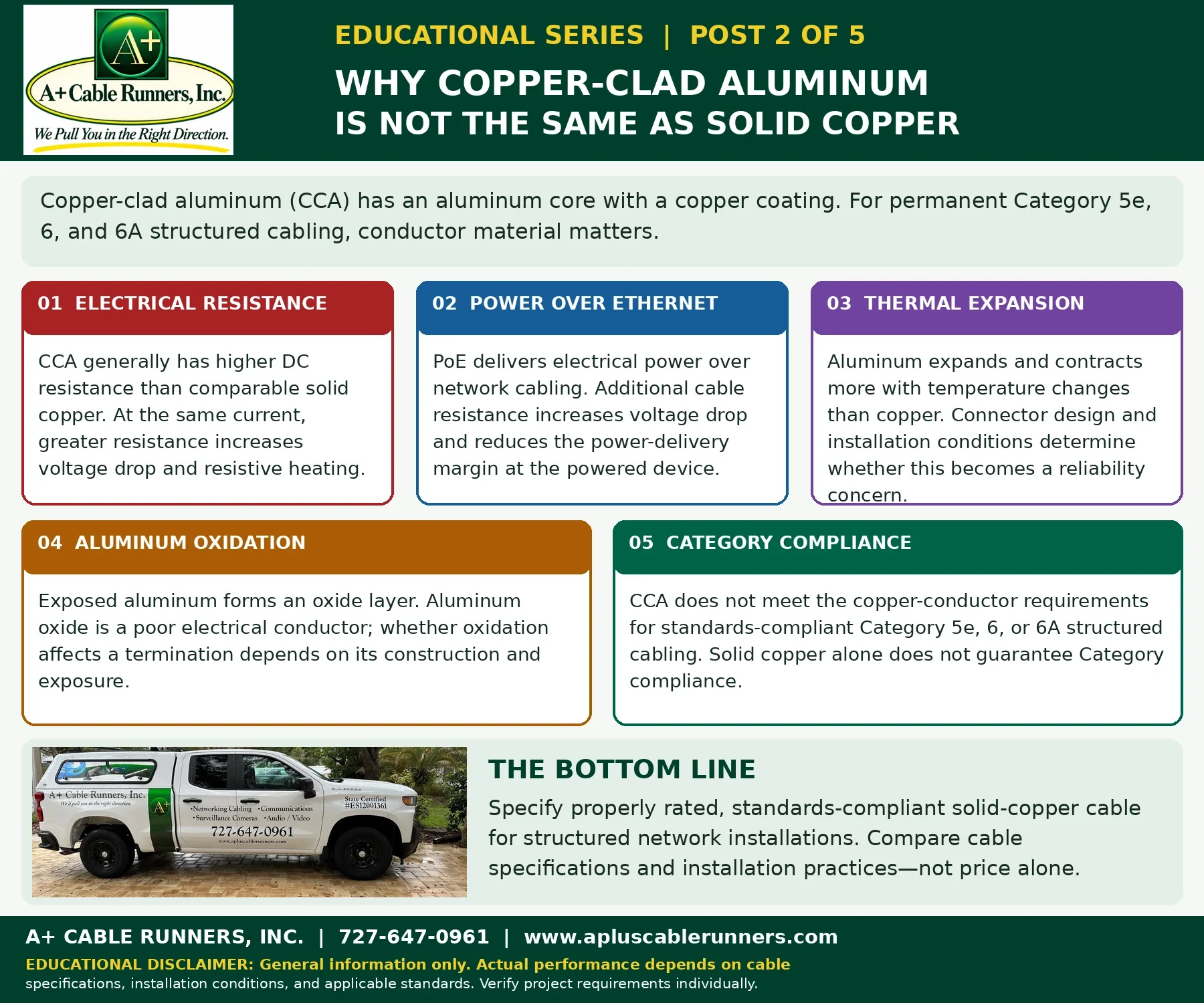
This post goes with post 2 of our five-part educational series on network cable. Post 1 covered what to compare in network cable besides price.
Copper-clad aluminum, or CCA, is cable with an aluminum core and a copper coating. From the outside, and even with the jacket stripped back, it can look a lot like solid copper. For permanent Category 5e, 6 and 6A structured cabling, though, the conductor material matters. Here are five ways the two differ.
1. Electrical resistance
CCA generally has higher DC resistance than comparable solid copper. At the same current, greater resistance increases voltage drop along the cable and resistive heating in the conductors. Fluke Networks, which makes cable test equipment, lists higher DC resistance as one of the main concerns with CCA.
2. Power over Ethernet
Power over Ethernet (PoE) delivers electrical power over the network cable to devices such as cameras, wireless access points and phones. Additional cable resistance increases voltage drop and reduces the power-delivery margin at the powered device. Fluke Networks notes that CCA's greater resistance means lower voltage at the device and more heating in the cable. Post 3 of the series covers PoE in more detail.
3. Thermal expansion
Aluminum expands and contracts more than copper with temperature changes. Engineering references list aluminum's coefficient of linear expansion as noticeably higher than copper's. Whether that becomes a reliability concern depends on the connector design and the installation conditions.
4. Aluminum oxidation
Exposed aluminum forms an oxide layer, and aluminum oxide is a poor electrical conductor: a National Bureau of Standards report on aluminum wiring calls it an excellent insulator. In CCA, the copper coating covers the aluminum, so the question is what happens where that coating is nicked, scraped or cut, such as at a termination. Whether oxidation affects a given termination depends on how it was made and what it is exposed to.
5. Category compliance
CCA does not meet the copper-conductor requirements for standards-compliant Category 5e, 6 or 6A structured cabling. Fluke Networks notes that the standards require solid copper conductors, and quotes the Communications Cable and Connectivity Association saying CCA should not be called category cable because it does not meet them.
Solid copper alone does not guarantee Category compliance either. The cable also has to meet the performance requirements of its category, which is what certification testing checks. Post 4 of the series covers the difference between a basic cable test and certification.
How to spot CCA
- Read the jacket and the specification sheet. Look for the conductor material, the category and the listing.
- Look at a cut conductor. Fluke Networks suggests scraping a conductor: silver-colored metal under the copper means aluminum.
- Notice the weight. Aluminum is lighter than copper, though Fluke warns that counterfeiters sometimes add ballast to a box.
The bottom line
Specify properly rated, standards-compliant solid-copper cable for structured network installations, and compare cable specifications and installation practices, not price alone. At A+ Cable Runners, we use properly rated, solid-copper network cable for that reason. To see the cabling work we do, visit our computer network cabling page.
General information only. Actual performance depends on cable specifications, installation conditions and applicable standards. Verify project requirements individually.