This is the third post in our five-part educational series on RJ45 connectors and keystone jacks.
Behind most network outlets in an office is a keystone jack. It is where the cable that runs through your walls and ceilings ends, and where a patch cord plugs in to connect a computer, phone, printer or access point. Choosing a compatible jack, terminating it correctly and testing every connection are what make that outlet reliable.
What is a keystone jack?
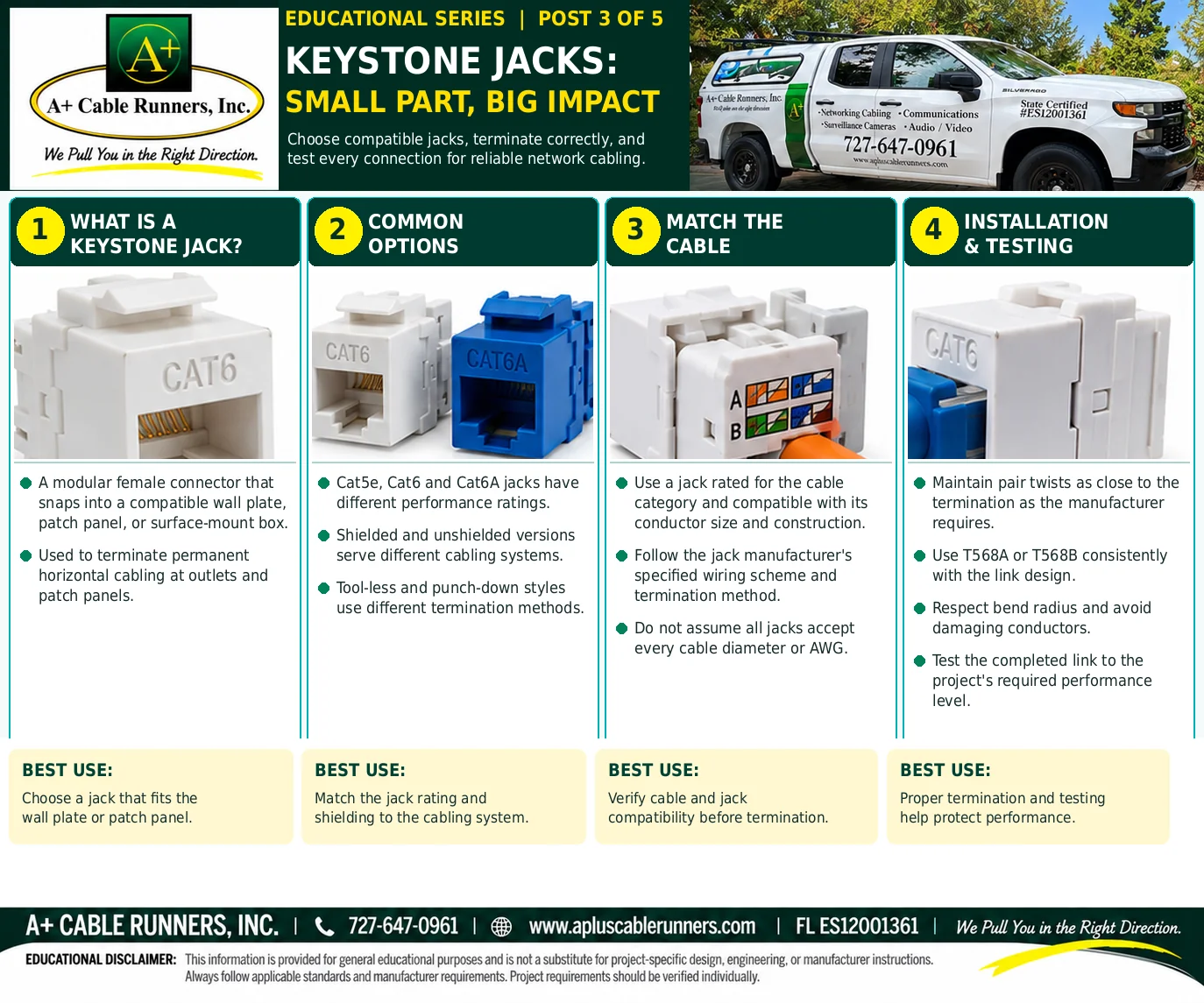
A keystone jack is a modular female connector that snaps into a compatible wall plate, patch panel or surface-mount box. It is used to terminate permanent horizontal cabling at outlets and at patch panels. Choose a jack that fits the wall plate or patch panel you are using.
Common options
- Category rating. Cat5e, Cat6 and Cat6A jacks have different performance ratings.
- Shielded or unshielded. Shielded and unshielded versions serve different cabling systems.
- Tool-less or punch-down. These styles use different termination methods.
Match the jack's rating and shielding to the cabling system it is part of.
Match the jack to the cable
Use a jack rated for the cable category and compatible with the cable's conductor size and construction. Follow the jack manufacturer's specified wiring scheme and termination method. And do not assume that every jack accepts every cable diameter or wire gauge: larger cables, such as many Cat6A cables, may need a jack designed for them. Verify cable and jack compatibility before terminating.
Installation and testing
- Maintain the pair twists as close to the termination as the manufacturer requires.
- Use the T568A or T568B wiring scheme consistently with the link design.
- Respect the cable's bend radius and avoid damaging the conductors.
- Test the completed link to the project's required performance level.
Testing is the step that proves the work. Our post on cable testing versus certification explains what a test does and does not tell you.
The bottom line
A keystone jack is a small part with a big impact on how the connection performs. Proper termination and testing help protect performance. Tomorrow's post 4 looks at what a bad connection actually costs. To see the cabling work we do, visit our computer network cabling page.
Information is provided for general education. It is not a substitute for project-specific design, engineering or manufacturer instructions. Always follow applicable standards and manufacturer requirements. Project requirements should be verified individually.