This is the fourth post in our five-part Network Cable Testing educational series.
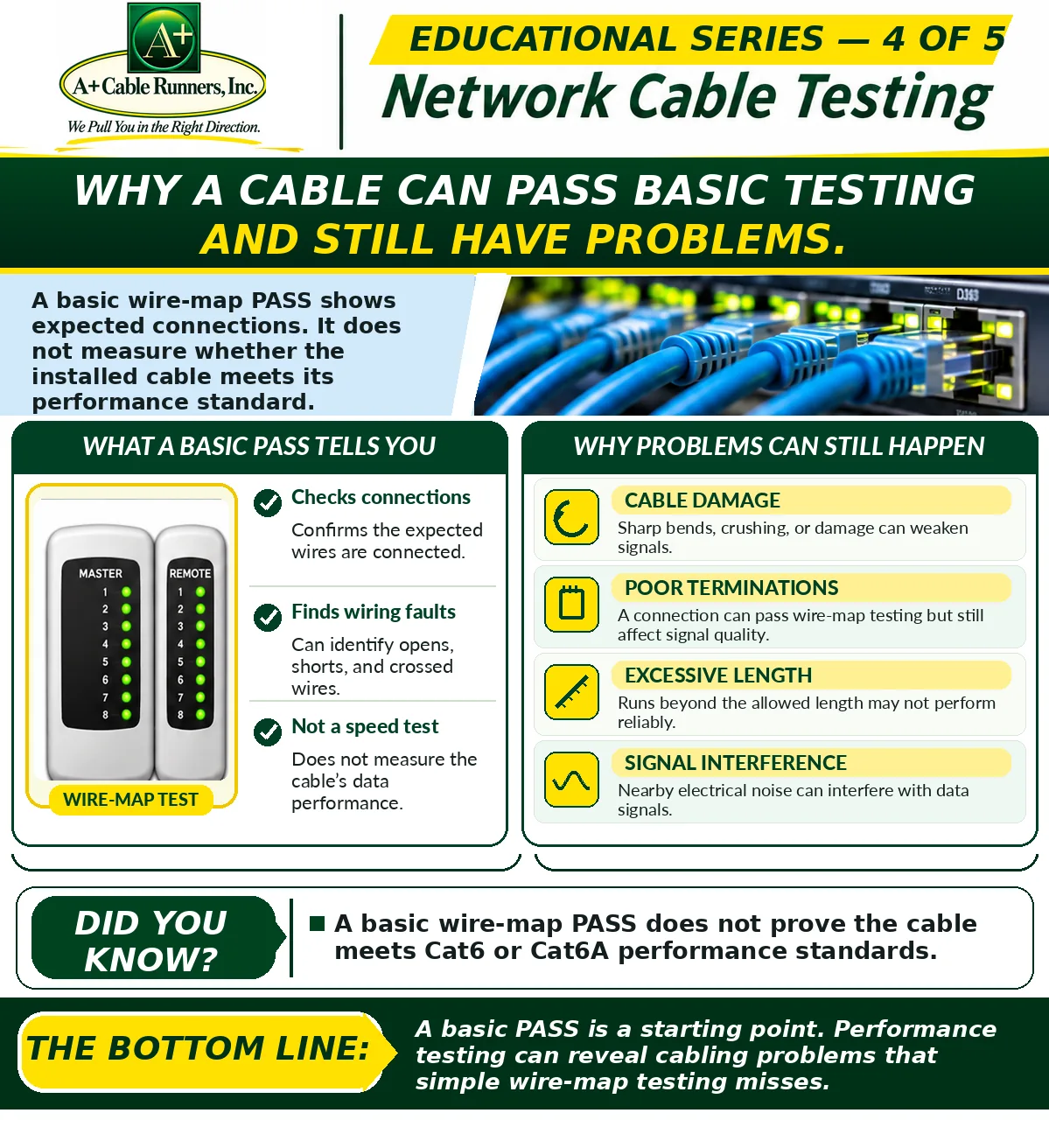
A basic wire-map PASS shows expected connections. It does not measure whether the installed cable meets its performance standard. Here is what a basic PASS tells you, and four reasons a cable that passes can still cause trouble.
What a basic PASS tells you
- Checks connections. Confirms the expected wires are connected.
- Finds wiring faults. Can identify opens, shorts and crossed wires.
- Not a speed test. Does not measure the cable's data performance.
Why problems can still happen
Each of the four problems below can leave every wire connected to the right pin, which is all a wire-map test looks for.
1. Cable damage
Sharp bends, crushing or damage can weaken signals.
Fluke Networks, which makes cable test equipment, lists kinked cables and removed twists among the causes of return loss failures, and names excessive compression from inappropriate bundling, such as plastic cable ties, as a cause of crosstalk (NEXT). Fluke also notes that knots and kinks don't always cause a failure, especially with good-quality cable. That is the point of measuring: it tells you which ones matter. Our post on cable sag, pulling tension and bend radius covers how good cable gets damaged during installation.
2. Poor terminations
A connection can pass wire-map testing but still affect signal quality.
Fluke's troubleshooting guidance says that in many cases, excessive crosstalk is due to poorly twisted terminations at the connection points, and that the amount of untwist should be kept to a minimum. The wires can be on the right pins with the pairs untwisted too far, and the wire map still reads PASS. Our post on keystone jacks covers why the jack and its termination matter.
3. Excessive length
Runs beyond the allowed length may not perform reliably.
Fluke states that the overall length of a channel, including the cabling and any cords, should not exceed 100 meters per industry standard guidelines, and that the maximum permitted length of the permanent link (the fixed cable, without the patch cords at the ends) is 90 meters. Fluke also notes that insertion loss, the signal lost along the run, is directly related to the length of a link. Some basic testers also measure length, but they do not measure the loss that comes with it.
4. Signal interference
Nearby electrical noise can interfere with data signals.
Twisted-pair cable relies on balance between the conductors to reject noise. Fluke explains that cable whose conductors are not properly balanced cannot cancel noise injected from outside, and that this shows up in balance (TCL and TCTL) and alien crosstalk results. Those are performance measurements; a wire-map tester does not make them.
Did you know?
A basic wire-map PASS does not prove the cable meets Cat6 or Cat6A performance standards.
The bottom line
A basic PASS is a starting point. Performance testing can reveal cabling problems that simple wire-map testing misses.
Next in the series, part five: Five Questions to Ask About Network Cable Testing. To see the cabling work we do, visit our computer network cabling page.
Educational information only. Cabling requirements and performance depend on the installation, equipment, applicable standards and intended application. This is not a substitute for project-specific design or engineering. Always follow applicable codes and manufacturer instructions, and verify project requirements individually.