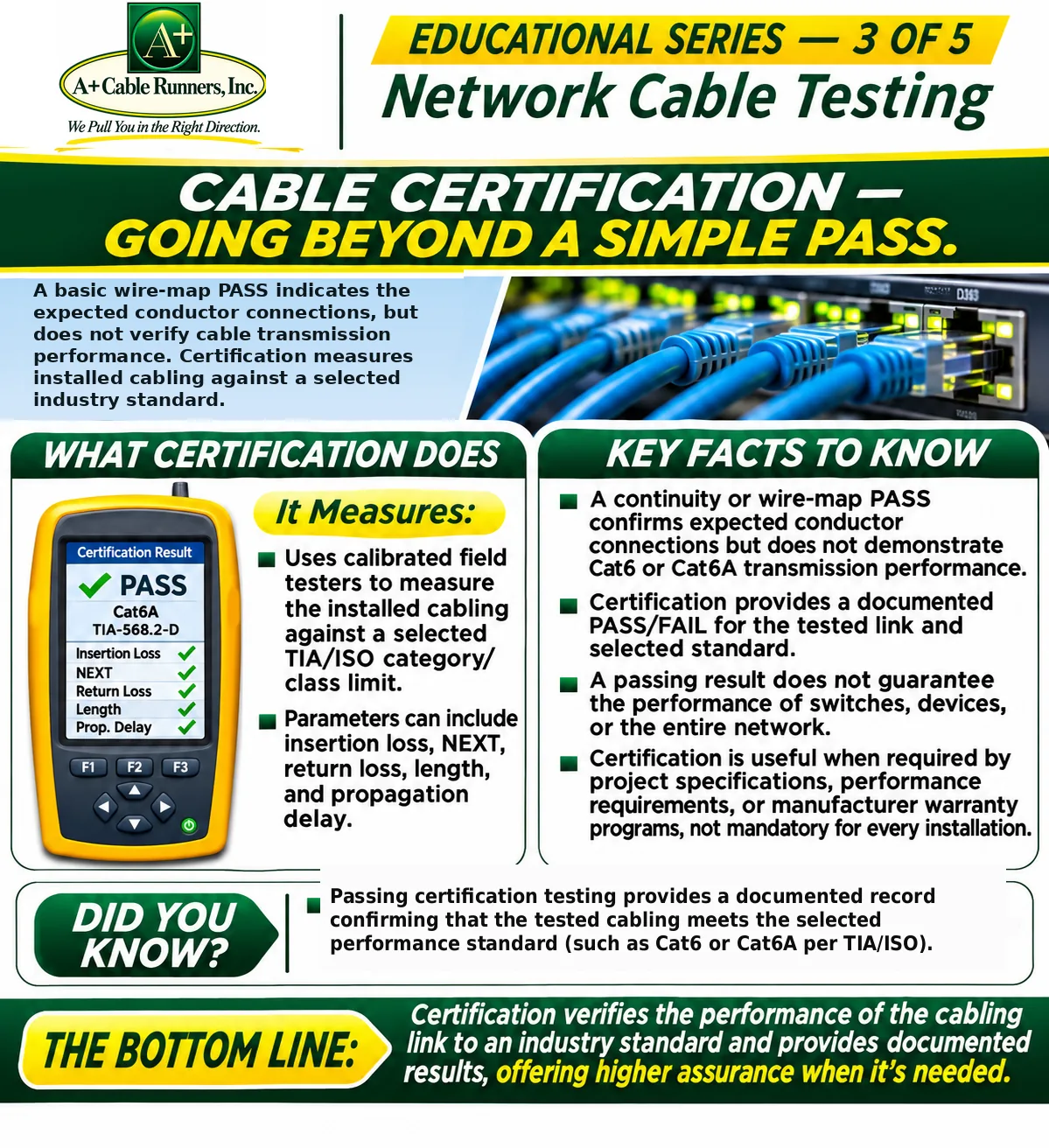
This is the third post in our five-part Network Cable Testing educational series.
A basic wire-map PASS indicates the expected conductor connections, but does not verify cable transmission performance. Certification measures installed cabling against a selected industry standard. The word that matters most in that sentence is "selected."
What certification does
It measures:
- Certification uses calibrated field testers to measure the installed cabling against a selected TIA/ISO category or class limit.
- Parameters can include insertion loss, NEXT, return loss, length and propagation delay.
Our earlier post on cable testing versus certification explains what each of those measurements means in plain terms.
Key facts to know
- A continuity or wire-map PASS confirms expected conductor connections but does not demonstrate Cat6 or Cat6A transmission performance.
- Certification provides a documented PASS/FAIL for the tested link and the selected standard.
- A passing result does not guarantee the performance of switches, devices or the entire network.
- Certification is useful when required by project specifications, performance requirements or manufacturer warranty programs. It is not mandatory for every installation.
Did you know?
Passing certification testing provides a documented record confirming that the tested cabling meets the selected performance standard (such as Cat6 or Cat6A per TIA/ISO).
Why the selected standard matters
A certification result is only as meaningful as the limit it was tested against. Three things are worth checking on any report:
- The category. A run tested to a Cat6 limit has not been shown to meet Cat6A.
- The edition of the standard. The tester screen in our graphic shows TIA-568.2-D. TIA released the next revision, ANSI/TIA-568.2-E, on October 24, 2024. According to Siemon, a cabling manufacturer, the revision brought in DC resistance unbalance limits for Category 5e, 6 and 6A cables, permanent links and channels, from an amendment on delivering power over twisted-pair cabling, and cabling claiming compliance to 568.2-D may not comply with 568.2-E. Our post on cable and Power over Ethernet covers why resistance matters when the cable carries power.
- Permanent link or channel. Fluke Networks describes the permanent link as the fixed cabling, which does not include the patch cords at the ends, with a maximum length of 90 meters. A channel test includes the patch and equipment cords used in the final installation.
If your project has a specification, it should say which category, standard and test configuration apply. If it doesn't, ask before the work starts, not after.
The bottom line
Certification verifies the performance of the cabling link to an industry standard and provides documented results, offering higher assurance when it's needed.
Next in the series, part four: Why a Cable Can Pass Basic Testing and Still Have Problems. To see the cabling work we do, visit our computer network cabling page.
Educational information only. Cabling requirements and performance depend on the installation, equipment, applicable standards and intended application. This is not a substitute for project-specific design or engineering. Always follow applicable codes and manufacturer instructions, and verify project requirements individually.