This post goes with post 3 of our five-part educational series on network cable. Post 2 covered how copper-clad aluminum differs from solid copper.
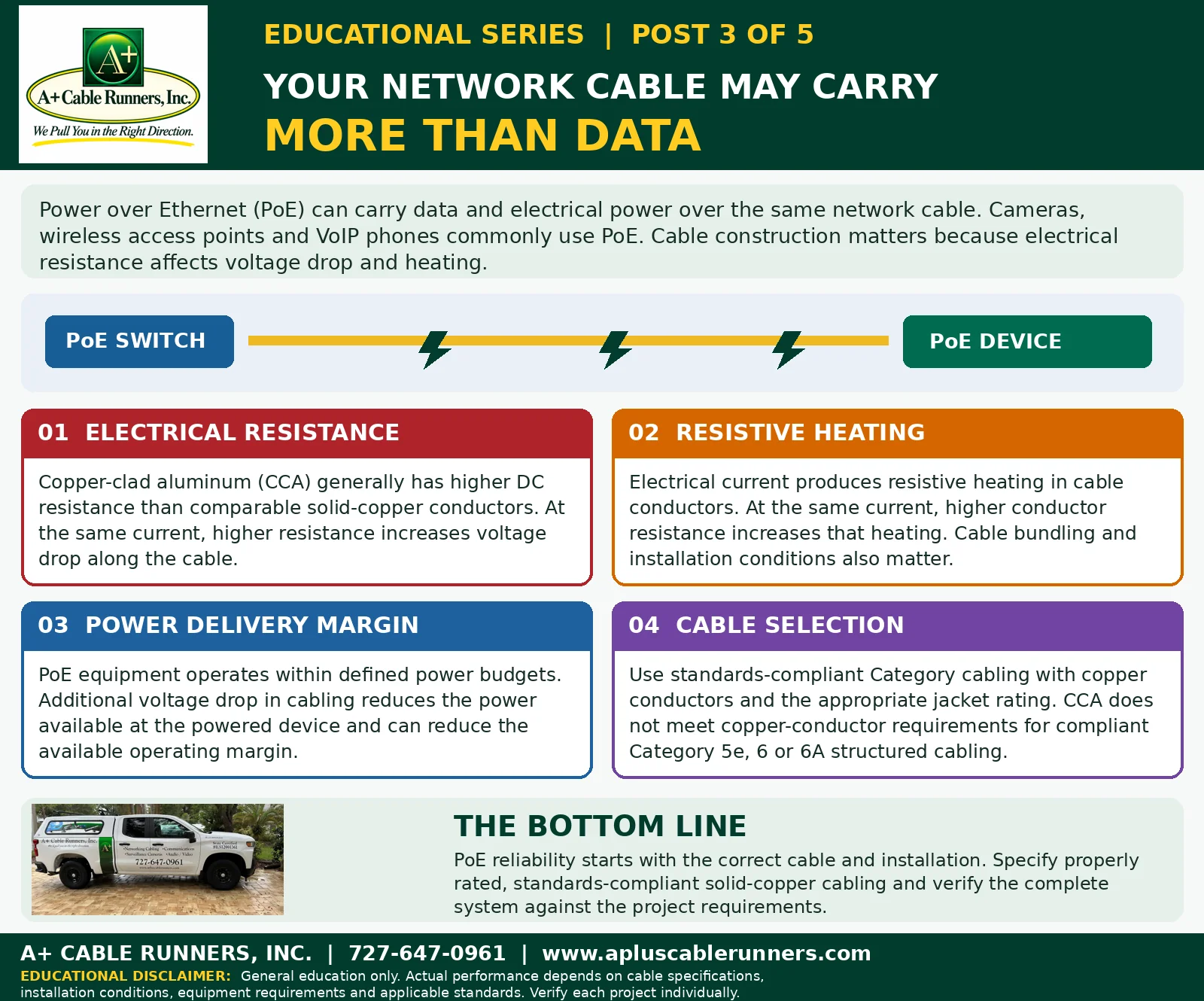
Power over Ethernet (PoE) carries data and electrical power over the same network cable. Security cameras, wireless access points and VoIP desk phones commonly use it, so the device needs only one cable and no outlet nearby. That convenience puts more demand on the cable: once it carries power, its electrical resistance affects voltage drop and heating, not just the data signal.
How the power gets there
A PoE switch in the network closet, or an injector for a single device, sends power down the cable alongside the data. Before it does, it checks that the device on the other end is designed to accept power. Along the way, some of that power is lost in the cable itself.
1. Electrical resistance
Copper-clad aluminum (CCA) generally has higher DC resistance than comparable solid-copper conductors. At the same current, higher resistance increases the voltage drop along the cable.
2. Resistive heating
Electrical current produces heat in cable conductors, and at the same current, higher conductor resistance increases that heating. Cable bundling and installation conditions also matter: heat builds up most where many powered cables run together. TIA's guidance on cabling for PoE (TSB-184-A) addresses that temperature rise in bundled cable.
3. Power delivery margin
PoE equipment works within defined power budgets. The IEEE standard sets how much power a switch port supplies and how much is guaranteed at the device, with the difference allowed for loss in the cable. According to the Ethernet Alliance, for example, an 802.3at (PoE+) port supplies up to 30 watts, and 25.5 watts is guaranteed at the device over cabling within the standard's resistance limit.
Additional voltage drop in the cabling reduces the power available at the powered device and can eat into its operating margin. Fluke Networks, which makes cable test equipment, says CCA's greater resistance means lower voltage at the powered device, and that CCA cables do not support PoE applications.
4. Cable selection
Use standards-compliant Category cabling with copper conductors and the jacket rating the space requires. CCA does not meet the copper-conductor requirements for compliant Category 5e, 6 or 6A structured cabling. For new installations that will carry power, TSB-184-A recommends Category 6A or better.
The bottom line
PoE reliability starts with the correct cable and installation. Specify properly rated, standards-compliant solid-copper cabling, and verify the complete system against the project's requirements: what each device draws, what each switch can supply and whether the cable gets the power there. A camera that powers up on installation day is a good start, not the whole check.
At A+ Cable Runners, we use properly rated, solid-copper network cable for the runs that power cameras, phones and access points. To see our camera work, visit our security camera installation page.
General education only. Actual performance depends on cable specifications, installation conditions, equipment requirements and applicable standards. Verify each project individually.