This is the second post in our five-part Network Cable Testing educational series.
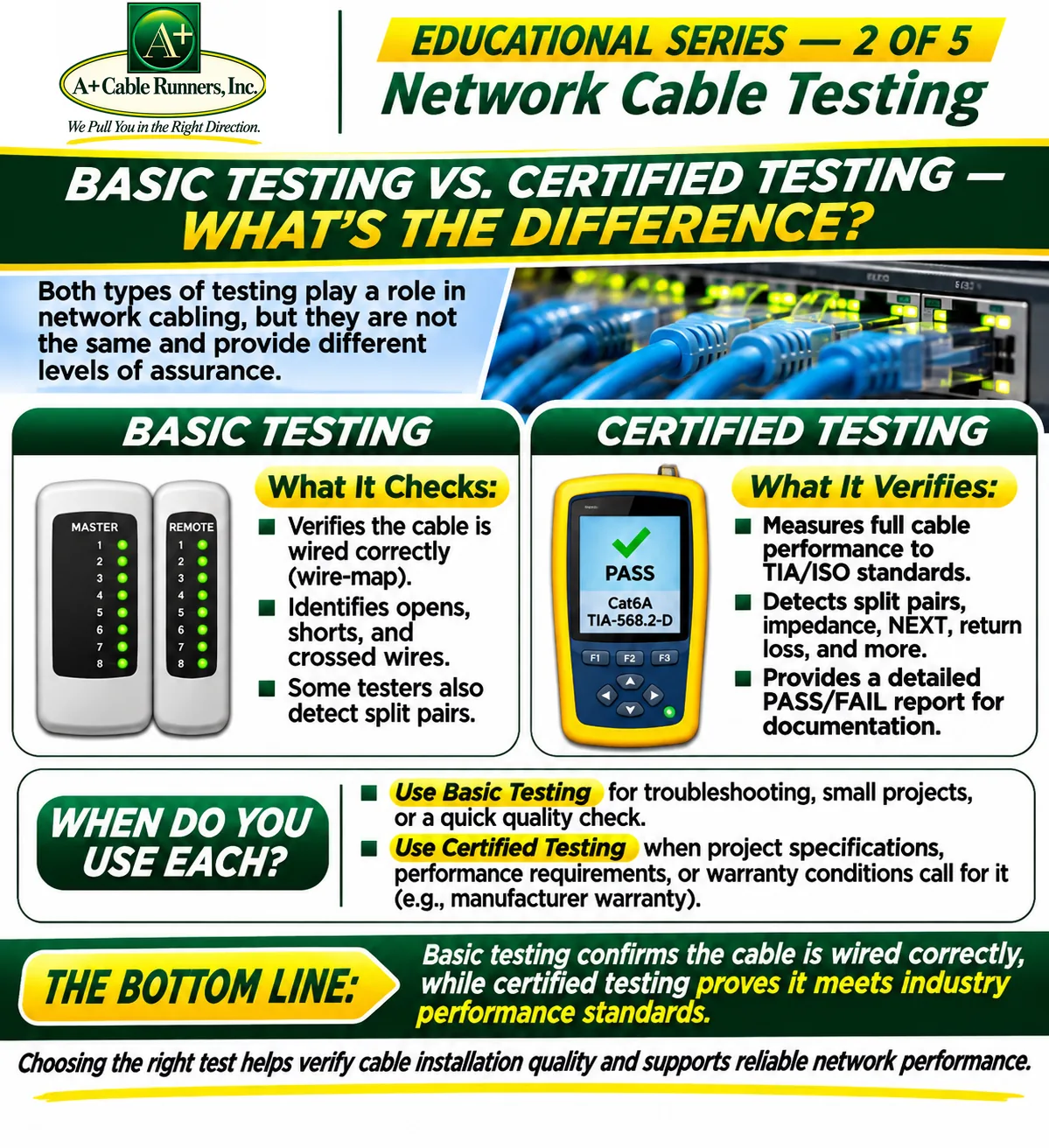
Both types of testing play a role in network cabling, but they are not the same and provide different levels of assurance. Here is what each one checks, and when to use each.
Basic testing: what it checks
- Verifies the cable is wired correctly (wire map).
- Identifies opens, shorts and crossed wires.
- Some testers also detect split pairs.
The tester in our graphic works in two pieces, a main unit at one end of the cable and a remote at the other. A split pair is a wiring mistake in which wires from two different twisted pairs are used together as one circuit. Fluke Networks lists split pairs as one cause of crosstalk (NEXT) failures. Not every basic tester catches them, but some verifiers do: Fluke's MicroScanner, for example, includes split pairs in its wire-map test.
Certified testing: what it verifies
- Measures full cable performance to TIA/ISO standards.
- Detects split pairs, impedance problems, NEXT, return loss and more.
- Provides a detailed PASS/FAIL report for documentation.
Impedance problems show up in the return loss measurement. Fluke notes that the impedance of a cable or patch cord should be 100 ohms, and that impedance that is wrong or not uniform is one cause of return loss failures. A basic tester does not measure either.
When do you use each?
- Use basic testing for troubleshooting, small projects or a quick quality check.
- Use certified testing when project specifications, performance requirements or warranty conditions call for it (for example, a manufacturer warranty).
Fluke calls basic testing the first line of defense when troubleshooting, and says certification is required by cabling manufacturers to receive a warranty. When one jack stops working, a basic tester is often the first tool out. Our post on repairing cabling versus replacing it covers what comes after.
The bottom line
Basic testing confirms the cable is wired correctly, while certified testing proves it meets industry performance standards. Choosing the right test helps verify cable installation quality and supports reliable network performance.
Next in the series, part three: Cable Certification: Going Beyond a Simple Pass. Part one, Your Network Cable Works, But Was It Tested?, introduced the two levels of testing. To see the cabling work we do, visit our computer network cabling page.
Educational information only. Cabling requirements and performance depend on the installation, equipment, applicable standards and intended application. This is not a substitute for project-specific design or engineering. Always follow applicable codes and manufacturer instructions, and verify project requirements individually.