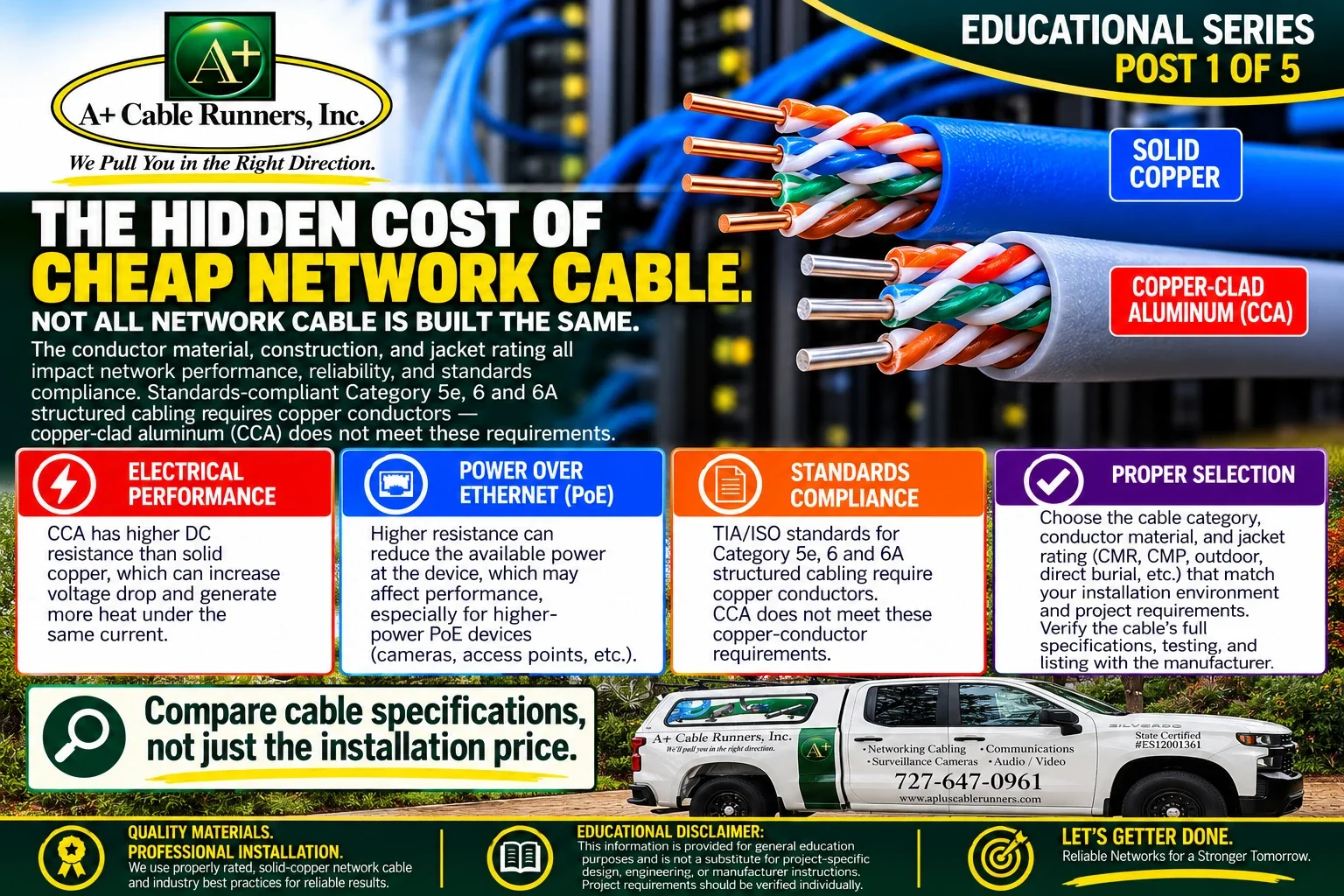
This post goes with post 1 of our five-part educational series on network cable.
Two network cables can look identical on the outside and still be very different products. The conductor material, how the cable is built and the jacket rating all affect how a network performs, how reliable it is and whether it meets the industry standards it claims. When cabling quotes are compared on price alone, those differences are easy to miss.
Solid copper and copper-clad aluminum
One common shortcut is copper-clad aluminum, usually shortened to CCA: aluminum conductors with a thin copper coating. Strip back the jacket and the wires look like copper. The difference is in the core.
The TIA and ISO/IEC standards for Category 5e, 6 and 6A structured cabling require solid copper conductors. Fluke Networks, which makes cable test equipment, says CCA cables do not meet those standards, and quotes the Communications Cable and Connectivity Association saying CCA should not be called category cable.
Electrical performance
CCA has higher DC resistance than solid copper. At the same current, more resistance means more voltage drop along the cable and more heat in the conductors.
Power over Ethernet
Many security cameras, wireless access points and desk phones get their power through the network cable, using Power over Ethernet (PoE). Higher resistance can reduce the power that reaches the device, which can affect how it performs, especially for higher-power PoE equipment. Fluke Networks notes that CCA's greater resistance means lower voltage at the powered device and more heating in the cable.
Standards compliance
Because the standards require copper conductors, CCA cannot be standards-compliant Category 5e, 6 or 6A cabling, whatever is printed on the box. The reverse is not automatic either: solid copper is one requirement, and the cable still has to meet the performance requirements of its category.
Proper selection
Choosing cable means matching it to the job, not just picking a category:
- Category: Cat5e, Cat6 or Cat6A, based on what the network needs to support now and later.
- Conductor material: solid copper for permanent structured cabling.
- Jacket rating: the National Electrical Code sets listings for where cable can go, such as CMR (riser) for vertical runs between floors and CMP (plenum) for ceiling spaces used for air handling. Outdoor and direct-burial runs need cable made for those conditions.
- Verification: check the cable's full specifications, testing and listing with the manufacturer, not just the label on the box.
Compare cable specifications, not just the installation price
When two cabling quotes are far apart, ask what cable each one is based on: the category, the conductor material, the manufacturer and the jacket rating. A lower price built on cable that does not meet the standard is not a like-for-like comparison.
At A+ Cable Runners, we use properly rated, solid-copper network cable and industry best practices for reliable results. To see the cabling work we do, visit our computer network cabling page.
This information is for general education. It is not a substitute for project-specific design, engineering or manufacturer instructions, and project requirements should be verified individually.