This is the first post in our five-part educational series on cable support and cable management.
Lift a ceiling tile in many offices and you will find network cable lying across the tiles, draped over the metal grid or tied to the thin wires that hold the ceiling up. It is a quick way to get from the closet to a desk, and once the tile drops back into place nobody sees it. But a suspended ceiling is not built to carry cable, and the space above it is not an excuse to skip proper support.
Why the ceiling is not a cable support
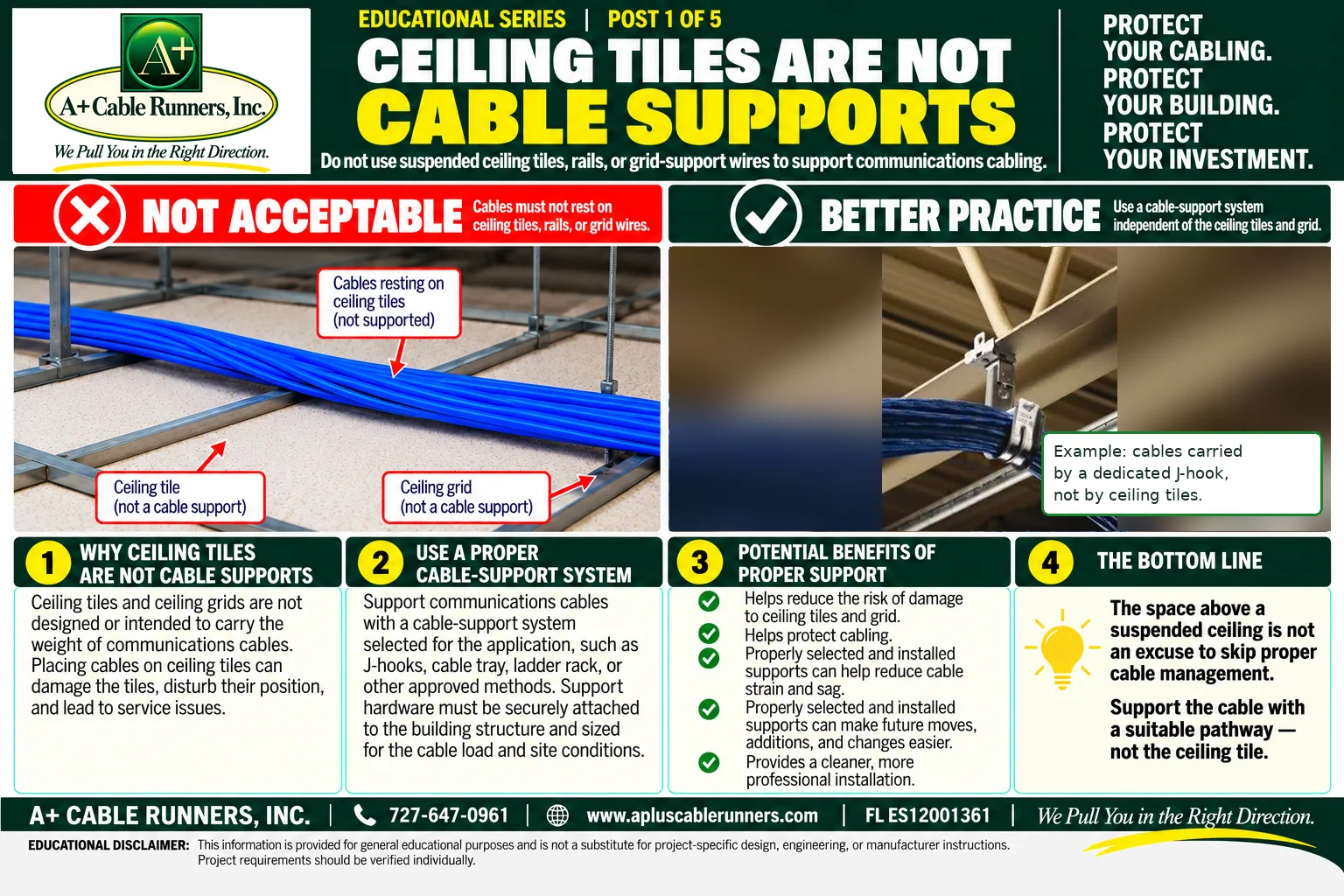
Ceiling tiles and ceiling grids are not designed or intended to carry the weight of communications cable. Cable placed on them can:
- Damage the tiles.
- Disturb their position, so tiles no longer sit properly in the grid.
- Lead to service issues.
What the electrical code says
The National Electrical Code requires exposed communications cable to be supported by the building structure, using straps, hangers, cable ties or similar fittings installed so they do not damage the cable. The code also does not allow cables to be supported by the ceiling grid or by the wires that hold up the ceiling. Separate support wires added for the cabling are one accepted alternative, as long as they can be told apart from the ceiling's own wires and are secured at both ends.
Florida enforces the edition of the code adopted with the Florida Building Code, and the local inspector has the final word on a given job. The basic rule, that the ceiling is not the support, has been in the code for years.
What a proper support system looks like
Communications cable should ride on a cable-support system selected for the application and attached to the building structure. Common choices include:
- J-hooks, hung from the structure at intervals along the route.
- Cable tray or basket tray, which supports the cable continuously along the route.
- Cable rings for appropriately sized bundles.
- Conduit, where cable needs an enclosed path or physical protection.
The hardware should be sized for the cable load and the site conditions. Post 2 of this series, publishing tomorrow, covers each type and where it fits.
What proper support can do for you
- Helps reduce the risk of damage to ceiling tiles and grid.
- Helps protect the cabling itself.
- Properly selected and installed supports can help reduce cable strain and sag.
- It can make future moves, additions and changes easier, because the cable is organized and easy to follow.
- It makes for a cleaner, more professional installation.
When you are getting cabling quoted
Ask how the cable will be supported above the ceiling, and whether the support hardware is included in the price. Our post on six questions to ask when comparing cabling bids covers routing and the other details that separate one bid from another.
The bottom line: support the cable with a suitable pathway, not the ceiling tile. To see the cabling work we do, visit our computer network cabling page.
Information is provided for general education. It is not a substitute for project-specific design, engineering or manufacturer instructions. Project requirements should be verified individually.