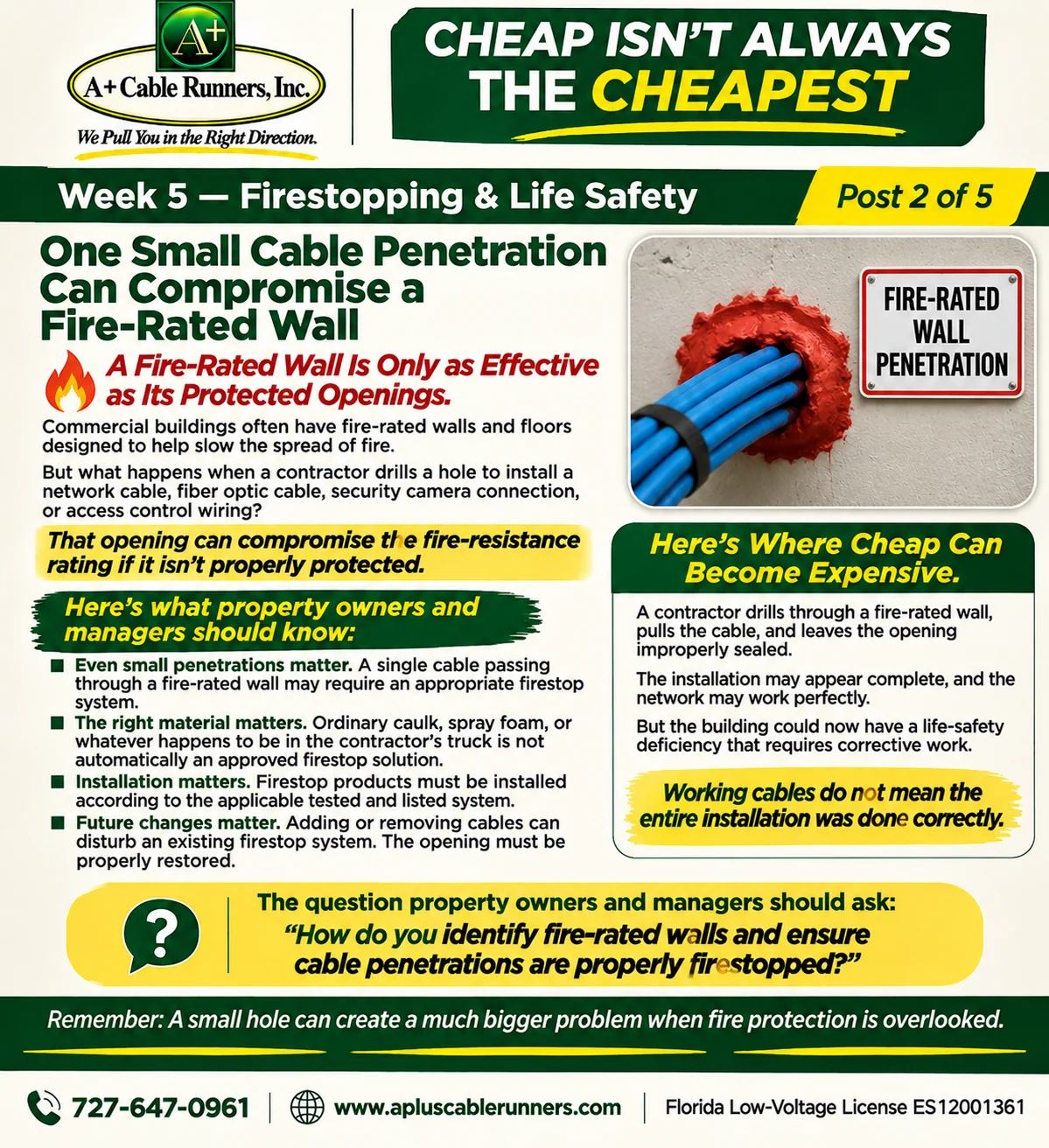
This is the second post in our five-part educational series on firestopping and life safety.
Commercial buildings often have fire-rated walls and floors designed to help slow the spread of fire. But what happens when a contractor drills a hole to install a network cable, fiber optic cable, security camera connection or access control wiring? That opening can compromise the fire-resistance rating if it isn't properly protected. A fire-rated wall is only as effective as its protected openings.
What property owners and managers should know
- Even small penetrations matter. A single cable passing through a fire-rated wall may require an appropriate firestop system.
- The right material matters. Ordinary caulk, spray foam or whatever happens to be in the contractor's truck is not automatically an approved firestop solution.
- Installation matters. Firestop products must be installed according to the applicable tested and listed system.
- Future changes matter. Adding or removing cables can disturb an existing firestop system. The opening must be properly restored.
Why the listing matters
A firestop system is tested as a whole: the type of wall or floor, the size of the opening, what passes through it and how the material is installed. That is why a product alone is not the answer. The International Firestop Council's inspection guidelines say that, with a few exceptions, firestop methods and materials are tested as a system, and that "a modification to a tested system voids the rating of the system." Where no tested system fits, they point to an engineering judgment reviewed by the local authority.
Where cheap can become expensive
A contractor drills through a fire-rated wall, pulls the cable and leaves the opening improperly sealed. The installation may appear complete, and the network may work perfectly. But the building could now have a life-safety deficiency that requires corrective work.
Working cables do not mean the entire installation was done correctly. A cable test tells you about the cable. Our post on cable testing versus certification explains what those tests cover, and neither one looks at the hole in the wall.
The question to ask
"How do you identify fire-rated walls and ensure cable penetrations are properly firestopped?"
A small hole can create a much bigger problem when fire protection is overlooked. To see the cabling work we do, visit our computer network cabling page.
Information is provided for general education. It is not a substitute for project-specific design, engineering or manufacturer instructions. Always follow applicable codes and listed system requirements. Project requirements should be verified individually.